
Reading Greyhound Form for Forecast Bets: A Punter’s Guide
 Available in US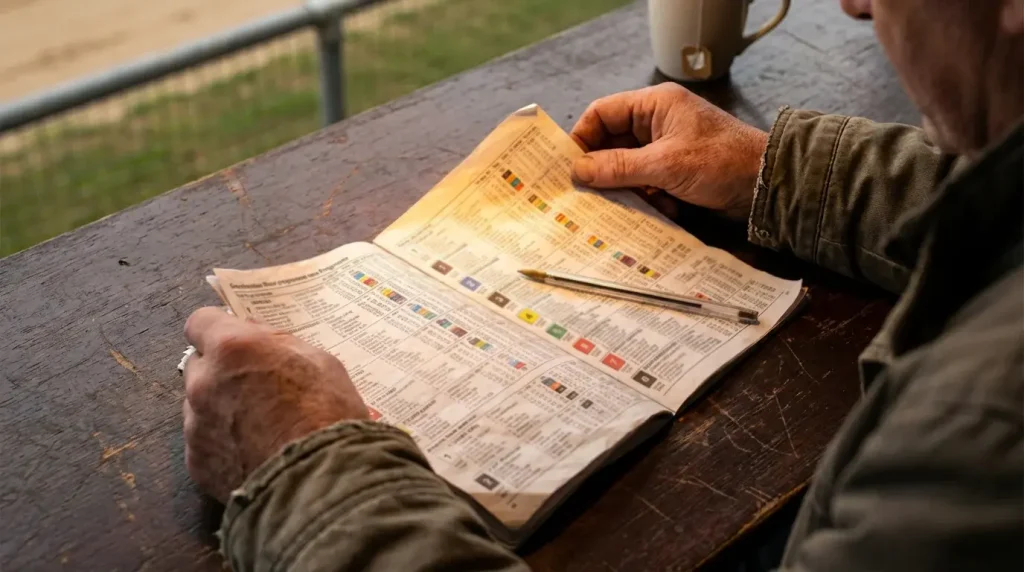
The Race Card Is Where Every Forecast Starts
Every forecast bet begins with a race card — and knowing how to read one separates punters from passengers. The card is a compressed data sheet: recent results, finishing times, trap assignments, grades, trainers, and comments condensed into a grid that tells you almost everything about a dog’s current form if you know where to look. The punter who skims the card and picks two dogs based on name recognition or trap colour is playing a different game entirely from the one who reads the data, maps the pace, and identifies the most likely finishing sequence.
Form reading for greyhound forecasts is different from form reading for win bets. A win bet asks a single question: which dog finishes first? A forecast demands a sequence — first and second, in order. That means you are not just identifying the strongest dog in the race; you are ranking the field, assessing relative ability, and predicting how each runner interacts with the others on the track. Two dogs might both have strong recent form, but if their running styles create a first-bend collision course, one of them is likely to be compromised, and that detail changes your forecast.
This guide walks through every element of the greyhound race card that matters for forecast selection: form figures, finishing times, trap draws, sectional data, running styles, and trainer patterns. The goal is not to turn you into a form-reading savant overnight — that takes months of practice — but to give you a structured framework for extracting the information that most directly influences finishing order, which is the foundation of every profitable forecast bet.
Anatomy of a Greyhound Race Card
A greyhound race card compresses a dog’s recent history into a single row of data. Every licensed GBGB track in the UK publishes race cards for each meeting, and these are available through the track’s own site, through data providers like Timeform and the Racing Post, and through most bookmaker platforms. The layout varies slightly between sources, but the core information is standardised. Here is what each element means and how it connects to forecast selection.
Form Figures
The form line is a sequence of numbers representing a dog’s finishing positions in its most recent races, typically displayed from left to right with the oldest result first and the most recent last. A form line of 3-1-2-1-4-2 tells you the dog finished third, first, second, first, fourth, and second in its last six outings. Some cards include letters alongside the numbers: “F” for fell, “T” for trapped at the start (a slow break from the traps), and “Dis” for disqualified.
For forecast purposes, you are looking for dogs that finish consistently in the first two positions. A form line showing multiple firsts and seconds — particularly in recent runs — identifies a dog that regularly occupies the forecast placings. A dog showing 1-1-2-1 is an obvious first-or-second candidate. A dog showing 3-4-3-5 is not a forecast contender based on recent form, regardless of what it achieved three months ago. Recency matters. Greyhound form deteriorates faster than many punters assume, especially in dogs racing two or three times per week, and a run of poor finishes usually signals a genuine downturn rather than bad luck.
One subtlety: the number alone does not tell you the quality of the race. Finishing second in an A1 graded race at Nottingham is a stronger signal than winning a low-grade trial at a smaller track. The grade and track context modify the raw number, and experienced form readers always cross-reference finishing position with race grade.
Times and Distances
Each form line entry includes the finishing time, typically shown in seconds to two decimal places (for example, 29.47 over 480 metres). The time tells you two things: the dog’s absolute speed at that distance, and, when compared across its recent runs, whether it is running faster or slower than its recent average. A dog that posted 29.30 three runs ago and has since clocked 29.65, 29.72, and 29.80 is slowing down — either through fitness decline, injury, or a step up in grade against stronger competition.
Distances — how far behind the winner each dog finished — are often expressed in lengths. One length in greyhound racing equates to approximately 0.08 seconds at standard sprint distances. A dog beaten two lengths finished about 0.16 seconds behind the winner. For forecast betting, the dog that finishes one or two lengths behind the winner regularly is a strong second-place candidate. A dog that finishes six lengths behind rarely figures in the forecast unless the pace dynamics of today’s race are substantially different from its previous outings.
Track distance also matters. UK greyhound racing uses various distances — from around 210 metres at some tracks up to 900 metres or more for marathon events. A dog’s form over 480 metres does not reliably predict its performance over 640 metres. When assessing forecast candidates, always check that recent form was recorded at the same or a comparable distance to today’s race.
Trap and Grade
The trap number indicates which starting box the dog runs from. UK greyhound racing uses a six-trap system with standardised colours: Trap 1 (red), Trap 2 (blue), Trap 3 (white), Trap 4 (black), Trap 5 (orange), and Trap 6 (black-and-white stripes). The trap assignment is not random — the racing manager allocates traps based on the dog’s running style and recent form to produce competitive, safe races. Rails runners (dogs that hug the inside rail) are typically drawn in the lower traps (1 and 2), while wide runners are assigned higher traps (5 and 6).
For forecast reading, the key question is whether today’s trap suits the dog’s preferred running line. A railer drawn in Trap 1 has a natural advantage: it breaks from the inside and can immediately hit the rail without crossing traffic. The same dog drawn in Trap 5 has to negotiate four other dogs to reach the rail, losing lengths and facing interference. Check the dog’s recent form for the trap it ran from in each race. If a dog has been winning from Trap 2 and is drawn in Trap 2 today, the form is directly comparable. If the same dog is drawn in Trap 6 for the first time, the form must be discounted — its previous finishing positions were achieved from a more favourable starting position.
The race grade — displayed as a letter-number combination like A3, A5, or OR (open race) — tells you the quality of opposition. GBGB tracks grade races from A1 (highest standard at that track) downward, with separate grades for different distances. A dog running in A3 after a string of A5 results has been upgraded based on recent wins, and it will now face faster opponents. This grade step can transform a form-line full of firsts and seconds into a mid-pack finisher. Always check whether the dog’s current grade matches its recent form-line grade.
Sectional Times: The Story Behind the Clock
Overall time tells you the result — sectional times tell you why. A sectional time splits the race into segments, typically measuring the time to the first bend (or first split) and then further splits to the finish. Where the overall time is a blunt instrument — dog A ran 29.40, dog B ran 29.55 — sectional times reveal the race within the race. Dog A might have posted a blistering first split of 4.10 seconds and then faded to 29.40, while dog B ran a slower 4.35 to the first bend but finished strongly. The overall times are close, but the profiles are completely different, and for forecast purposes, those profiles determine how each dog is likely to run today.
First-bend sectional times are the most valuable single data point for forecast betting because position at the first bend is the strongest predictor of finishing position in a six-dog greyhound race. Dogs that clear the first bend in front win more often than any other single-factor indicator would predict. A dog that consistently reaches the first bend in the top two positions — evidenced by fast first-split times — is a natural forecast contender, particularly for the first position in your forecast.
Not all tracks or data providers publish sectional times with equal accessibility. Timeform includes sectional data in its race cards for most GBGB tracks. The Racing Post provides some split data depending on the meeting. Track-side data screens at the venue often display the most detailed sectional breakdowns, but these are only available if you attend in person. For online punters, Timeform is generally the most reliable source of sectional data for UK greyhound racing.
When using sectional times for forecast selection, compare a dog’s first-split time against its rivals in the same race, not against dogs at other tracks. Track geometry, bend angles, and distance to the first bend vary between venues, so a 4.10 first split at Monmore is not directly comparable to a 4.10 at Romford. The comparison that matters is relative: which dogs in this specific race run the fastest early sections? Those are your likely first-bend leaders, and from there, finishing position follows a pattern that experienced form readers learn to recognise.
Running Styles and How They Shape the Race
A greyhound’s running style is its fingerprint — and it determines how it interacts with the race around it. Unlike horse racing, where jockeys can adjust tactics mid-race, greyhounds run on instinct. A dog that hugs the rail will hug the rail every time. A dog that runs wide will swing wide off every bend. These tendencies are consistent, observable in the form data, and directly relevant to forecast betting because they determine which dogs will crowd each other, which will have clear runs, and which will lose ground through interference.
Railers
Railers are dogs that naturally seek the inside rail and run their race along it. In a six-trap race, Trap 1 is the rail position, and dogs drawn there with a railing tendency have the shortest route around the track. Railers from Trap 1 break, hit the rail, and stay on it — covering the minimum distance and avoiding the crowding that occurs on the outside of the first bend.
A railer drawn in a higher trap — say Trap 3 or Trap 4 — faces a problem. To reach the rail, it needs to cut across the paths of dogs on its inside, and that manoeuvre costs time and risks interference. Some railers are skilled enough to negotiate this crossing early and still recover, but many lose two or three lengths in the process, which often proves decisive in a short sprint race. When reading form for a railer drawn in a trap wider than its usual assignment, discount its recent form by a margin proportional to how far across the track it needs to travel.
For forecast selection, a strong railer drawn in Trap 1 or Trap 2 is one of the most reliable selection types in greyhound racing. The combination of inside draw, natural rail-seeking behaviour, and short running distance creates a systematic advantage that shows up repeatedly in finishing statistics. If the race card shows a dog with fast early splits and a railing tendency drawn inside, that dog belongs in your forecast calculations — usually as the first selection.
Middle Runners and Wide Runners
Middle runners and wide runners operate differently. A middle runner takes a line between the rail and the outer boundary, typically settling into second or third position around the bends. These dogs are less predictable in terms of racing line because their path depends heavily on where the dogs around them go. A middle runner in a race with a dominant railer and a wide runner might find clear space; the same dog in a race with two middle runners on either side might get squeezed into interference.
Wide runners swing to the outside around the bends, covering more ground but often finding cleaner air. In races where the inside positions are congested — three or four dogs competing for rail position at the first bend — the wide runner can bypass the chaos and maintain its stride. The trade-off is distance. A wide runner covers several more metres per lap than a railer, which translates to time lost. At UK tracks, the difference between the widest and tightest racing line on a standard bend is roughly two to three lengths.
The interaction between running styles is where form reading for forecasts becomes genuinely analytical. If the race card shows a fast railer in Trap 1, two middle runners in Traps 3 and 4, and a wide runner in Trap 6, you can begin to map the likely shape of the first bend: the railer leads on the inside, the middle runners jostle for position behind it, and the wide runner sweeps around the outside. The railer is your likely first-position candidate. The wide runner, if it has the pace to sustain its wider line, might pick up second — particularly if the middle runners interfere with each other and lose ground. That is a forecast you can construct from the form data before the race runs, and it is the kind of analysis that separates profitable forecast punters from those relying on luck.
Trainer and Kennel Form
Trainers do not run races, but their decisions shape them — entries, fitness, kennel confidence. The trainer’s name appears on every race card entry, and while it rarely receives the same attention as trap draw or finishing time, it carries information that affects forecast selection in ways that are easy to overlook.
A trainer in strong form — consistently placing dogs that finish in the first two — is sending runners that are fit, well-prepared, and entered in races where they are competitive. Trainer form can be assessed over rolling periods of fourteen or twenty-eight days, and most data providers track trainer strike rates at this granularity. A kennel running at a 25% win rate over the last month is placing dogs to win, and those runners deserve extra consideration in your forecast.
Conversely, a trainer whose dogs have been finishing fourth, fifth, and sixth over a sustained period may be dealing with kennel-wide fitness issues, injury recovery, or a string of dogs stepping up in grade before they are ready. Individual dog form may still look reasonable on the card, but if nothing from that kennel has hit the frame in two weeks, the form figures may be painting a rosier picture than the current reality supports.
One pattern specific to UK greyhound racing: some trainers are known for their success at specific tracks. A trainer based near Monmore whose dogs race primarily at Monmore will have a deeper understanding of the track’s characteristics — bend angles, surface tendencies in different weather, trap bias patterns — than a trainer sending a dog there for the first time. Track familiarity at the kennel level is a subtle edge, but over a large sample of races, it contributes to finishing-position consistency, which is exactly what forecast punters need.
Putting It All Together for Forecast Selection
Form reading for forecasts means ranking not just winners, but sequences. The individual elements — form figures, times, trap draw, sectional data, running style, trainer form — each contribute a piece of information. The skill is in combining them into a coherent picture of how the race is likely to unfold and which two dogs are most likely to be at the front when it finishes.
Start with the pace map. Identify which dogs have the fastest first-split times and are drawn in traps that allow them to express that early speed. The dog with the best combination of early pace and favourable draw is your provisional first-place selection. Then look for the most likely second-place finisher: a dog with strong recent form, a trap that avoids the first-bend congestion, and a running style that complements rather than conflicts with your first selection. A railer first / wide runner second is a classic forecast structure because the two dogs take different paths around the track and rarely interfere with each other.
Cross-check your provisional forecast against grade. If your first selection has been racing in A5 and today’s race is graded A3, the dog is stepping up against faster opposition, and its recent form may not translate. If your second selection has just dropped from A2 to A3 following a poor run, it might be facing weaker competition and is primed for a return to the first two positions. Grade movement adds a layer of context that raw form figures miss.
Finally, check the trainer form for both selections. If both dogs come from kennels in strong current form, that reinforces the selection. If one dog’s kennel is in a slump, consider whether the individual dog’s form is strong enough to override the kennel trend, or whether the pattern suggests a deeper issue.
The entire process takes three to five minutes per race once you are practised. For a typical evening meeting with twelve races, that is less than an hour of analysis to identify the three or four races where your form reading produces a confident forecast view. The rest of the card — the races where the data is ambiguous, where three dogs are inseparable, or where a first-time entry makes the field unpredictable — can be left alone. Selective betting based on thorough form reading produces better returns than blanket coverage based on shallow analysis.
When Form Lies
Form is a compass, not a guarantee — and certain patterns signal that the data has expired. Knowing when to trust the race card and when to discount it is as important as knowing how to read it. Several scenarios in UK greyhound racing produce form figures that look reliable on paper but are misleading in practice.
The most common is a long absence. If a dog’s most recent run was more than twenty-one days ago, the form line may not reflect its current fitness. Greyhound fitness deteriorates with inactivity, and a dog returning from a break — whether due to injury, season, or kennel rest — needs at least one run to return to its previous level. Treat the first race back from a break of three weeks or more as a fitness indicator rather than a form guide. If the dog performs well on return, it becomes a forecast candidate for its next outing. If it fades or finishes mid-pack, the old form is unreliable.
Grade changes, as discussed, alter the form context. But there is a subtler version: track switches. A dog with strong form at Romford switching to its first run at Swindon faces different bend angles, distances, and surface characteristics. The form figures are real, but they were earned on a different circuit. Until the dog produces a result at the new track, its transferable form is uncertain.
Weight changes can also undermine form. Most race cards list the dog’s racing weight, and a gain or loss of more than half a kilogram from its previous race can signal changes in condition. A sudden weight drop might indicate a dog that has been unwell; a gain might mean a dog that has been rested and is carrying extra condition that could slow it in the early stages. Weight fluctuation within a narrow band (0.2-0.3 kg) is normal, but anything beyond that warrants a note in your form analysis.
Finally, beware of form compiled against weak opposition. A dog that has won its last three races in A7 grade is about to be moved up, and its winning streak may end abruptly when it meets A5 or A4 standard. The form figures say “winner” — the context says “untested at this level.” For forecast purposes, a dog with mixed results at a higher grade often represents better value than a dog with a clean record at a lower grade that is about to be tested.
The Form Student’s Edge
The punter who reads the card reads the race before it runs. That is not a guarantee of profit — greyhound racing produces surprises that no amount of form analysis can anticipate — but it is an edge that compounds over time. A form reader who correctly identifies the most likely first-and-second sequence in 25% of races is operating at a level that, combined with sensible staking, produces a positive return over any reasonable sample size.
The edge does not come from any single data point. It comes from the habit of reading the entire card, every race, every meeting, until pattern recognition becomes second nature. The railer drawn inside with fast splits. The wide runner with a clear outside path. The dog dropping in grade with a trainer in form. These are not revelations — they are recurring structures in UK greyhound racing, visible to anyone who invests the time to look. The form student’s edge is simply the discipline to look, consistently, before every bet.
Most punters will not do this. They will glance at the card, favour a familiar dog or a popular trap, and place their forecast based on instinct rather than analysis. That is fine for entertainment. But if the objective is sustained profitability from forecast betting, the race card is where the work happens, and the work is its own reward — because the patterns, once you see them, make every race a more interesting puzzle than the result alone could ever be.
Find more form guides at greyhoundforecast.
Also read our how to read a greyhound race card.
