
Greyhound Forecast Betting: The Complete UK Guide
 Available in US
How each forecast bet works, what it pays, and how to select the first two home.
Contents
Greyhound Forecast Betting — What It Is and Why It Rewards Sharper Punters
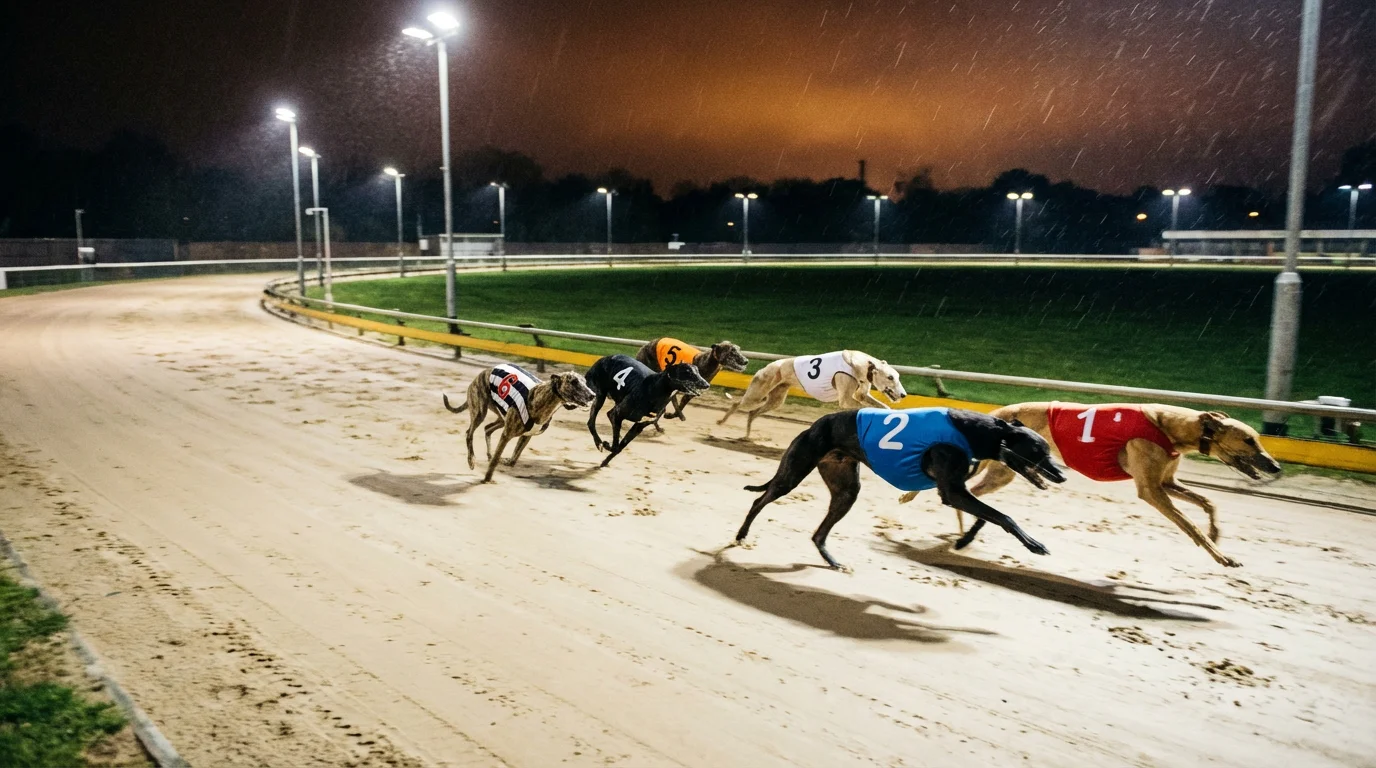
A forecast bet asks you to do something deceptively simple — name the first two greyhounds past the post, in the right order. Not just the winner. Not the dog that shows promise at the first bend then fades into fourth. The first and the second, precisely sequenced. That single requirement transforms a straightforward wager into something considerably more demanding, and considerably more rewarding when you get it right.
In a six-dog greyhound race, there are thirty possible finishing combinations for the top two positions. A win bet gives you a one-in-six shot. A straight forecast gives you one in thirty. The maths alone explains why forecast dividends routinely dwarf win-bet returns — and why most casual punters avoid them entirely. That avoidance, incidentally, is part of the opportunity. Forecast betting pools tend to attract fewer participants with less analytical rigour, which means the pricing inefficiencies are larger and more frequent than you will find on standard win markets.
UK greyhound racing runs around seventy-four meetings per week across licensed GBGB tracks, with six-trap races that lend themselves naturally to forecast betting. Unlike horse racing, where field sizes can stretch past twenty runners and forecast permutations become unwieldy, the compact greyhound field keeps the maths manageable while still offering genuine analytical depth. Trap draws, sectional times, running styles, early pace — each variable feeds directly into forecast selection in ways that broader fields dilute. All eighteen GBGB-licensed stadia run six-dog races as standard.
This guide covers every dimension of greyhound forecast betting for UK punters. From the mechanical differences between straight, reverse, and combination forecasts to the form-reading techniques that separate informed selections from hopeful stabs. From dividend calculations and pool mechanics to the strategic decisions that determine whether forecast betting becomes a structured edge or an expensive habit. The 2026 GBGB racing calendar offers a full slate of open races, graded meetings, and major events — all of them producing forecast markets that reward preparation over instinct.
Whether you are placing your first forecast at a tote window or refining a system built on years of race-card analysis, the framework here applies. Forecast betting is not about predicting the unpredictable. It is about narrowing thirty outcomes to the most probable sequence — and staking when the price reflects value.
Definition
A forecast bet requires you to predict the first two finishers in a greyhound race in the correct order. The three main types — straight forecast, reverse forecast, and combination forecast — differ in how many finishing sequences your stake covers. Payouts are determined either by the tote pool dividend or by the Computer Straight Forecast (CSF) algorithm used by bookmakers.
Anatomy of a Forecast Bet
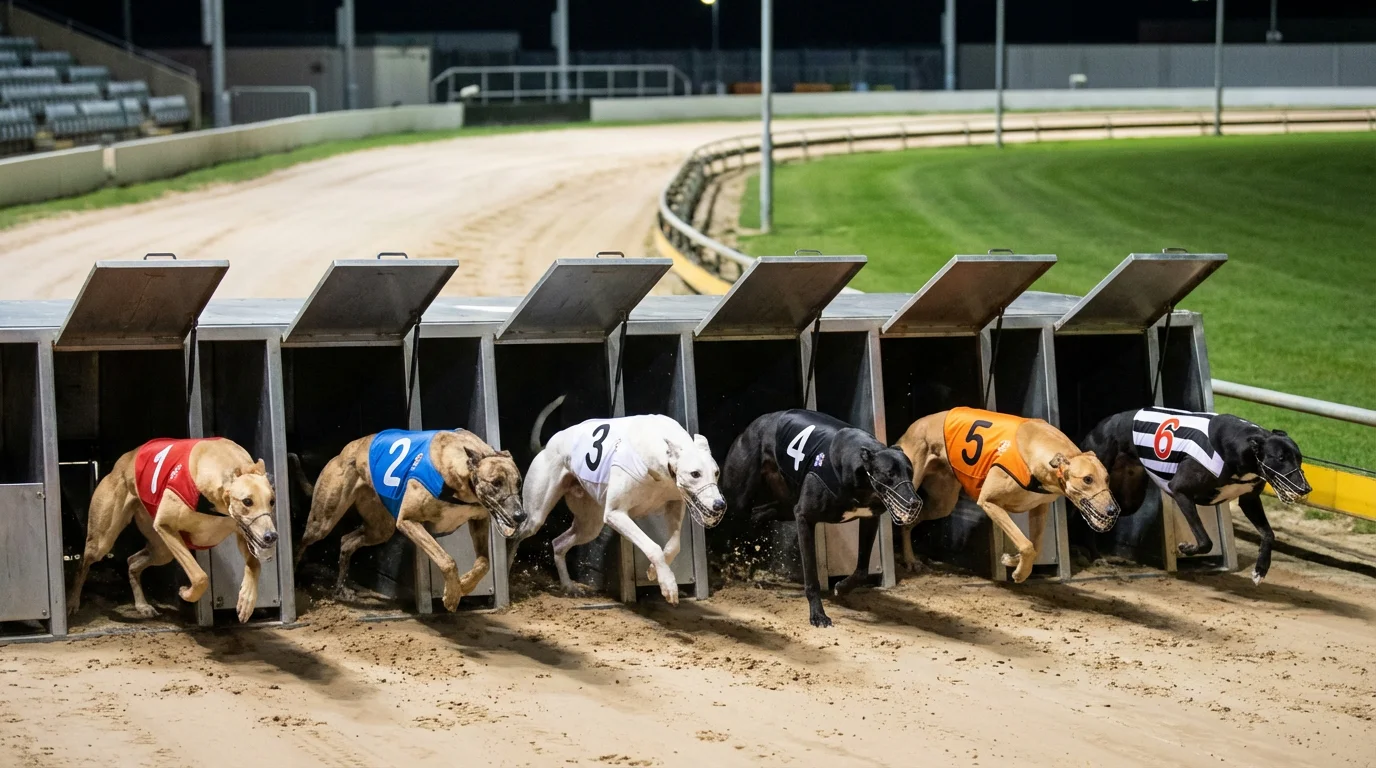
Before anything else, let's strip the forecast down to its mechanical parts. A greyhound forecast bet has four components: your selections (two greyhounds), the order requirement (which finishes first, which finishes second), your stake, and the settlement method that determines your return. Each component interacts with the others, and understanding the mechanics prevents the kind of confusion that costs money at the payout window.
The selections are straightforward — you pick two dogs from a six-runner field. But the order requirement is where the forecast distinguishes itself from other exotic bets. You are not simply picking two dogs to finish in the top two. You are specifying which dog crosses the line first and which crosses second. Get the two dogs right but the order wrong, and on a straight forecast, you lose. That precision is the entire point. It is also the entire risk.
The stake structure depends on the forecast type. A straight forecast is a single bet — one stake covers one specific finishing order. A reverse forecast is two bets, covering both possible orders of your two selections, so the stake is doubled. A combination forecast involves three or more selections, generating multiple straight forecasts across all possible pairings, and the total cost multiplies accordingly. The minimum stake at most UK tote windows is 50p per line, though online bookmakers frequently accept lower minimums.
Settlement is where things become more nuanced, because greyhound forecast bets can be settled in two fundamentally different ways. The tote forecast pays a pool dividend — your return depends on how much money was bet into the forecast pool for that race and how it was distributed across combinations. The bookmaker forecast, by contrast, pays based on the Computer Straight Forecast, an algorithm that calculates a theoretical fair return based on the starting prices of the first two finishers. These two methods can produce meaningfully different payouts on the same result, which is why experienced forecast punters often compare both options before committing their stake.
CSF — Computer Straight Forecast — an algorithm used by licensed bookmakers to calculate forecast returns based on starting prices. The CSF replaced the older board-price method and produces a standardised dividend that applies regardless of where you placed the bet.
One point of clarity that matters: in UK greyhound racing, "forecast" specifically means predicting the first two finishers. This is distinct from a "tricast," which demands the first three in order, and from the broader use of "forecast" in everyday language. When a race card, tote board, or bookmaker lists a "forecast" market, they mean first and second — nothing more, nothing less.
The Straight Forecast: One Order, One Chance
The straight forecast is the purest version — one bet, one exact order, no safety net. You select which dog finishes first and which finishes second, place your stake, and either both land in precisely that sequence or the bet loses. There is no partial credit, no consolation for getting the dogs right but the order wrong. That binary outcome is what generates the payout premiums.
Placing a straight forecast at a UK track is uncomplicated. At the tote window, you state your two selections and specify the order — "Trap 4 first, Trap 2 second" — along with your stake. Online, the process mirrors any standard bet: select the forecast market, choose your first and second picks from the available traps, set your stake, and confirm. Most bookmakers display forecast options alongside standard win and place markets on their greyhound racing pages. The minimum tote stake is usually 50p, though online operators frequently set minimums at 10p or 20p per line.
The payout on a straight forecast is not fixed at the time of betting. If you are betting through the tote, your return depends on the pool dividend declared after the race. If through a bookmaker, the CSF algorithm calculates your return based on the starting prices of the two dogs. In both cases, the return reflects the perceived difficulty of that particular combination. Two short-priced favourites finishing first and second might produce a dividend of £5 to £8 for a £1 stake. A less-fancied combination — say a 5/1 shot followed by an 8/1 outsider — could return £40, £60, or more.
What makes the straight forecast simultaneously attractive and punishing is the order requirement. Consider a race where you fancy Trap 4 and Trap 2 as the two strongest dogs. If Trap 4 wins and Trap 2 finishes second, your straight forecast pays. If Trap 2 wins and Trap 4 finishes second — the same two dogs, the same finishing positions relative to the field — your bet is a loser. Near-misses of this kind are the emotional tax of straight forecast betting, and they happen more often than most punters expect. In races with two closely matched front-runners, the finishing order can come down to trap draw, first-bend positioning, or a half-length gap at the line.
The strategic appeal of the straight forecast lies in the premium it pays for conviction. If your race-card analysis gives you a strong read on both the likely winner and the probable runner-up — not just two good dogs, but their likely finishing sequence — the straight forecast rewards that specificity with returns the win market cannot match.
Straight Forecast Example
| Selection | SP Odds | Stake | CSF Return |
|---|---|---|---|
| 1st: Trap 4 (Ballymac Doris) | 3/1 | £1 | £18.54 |
| 2nd: Trap 2 (Droopys Expert) | 5/1 |
The CSF return reflects the combined probability of both dogs finishing in this exact order. Had the positions reversed, the CSF would differ because the payout recalculates based on the actual finishing SPs.
The Reverse Forecast: Both Orders Covered
You have the dogs right but not the order — that frustration is precisely what the reverse forecast was designed to eliminate.
Double the cost, double the coverage — that's the reverse forecast trade-off. A reverse forecast is structurally two straight forecasts packaged into a single bet. You select two dogs, and your stake covers both possible finishing orders: Dog A first and Dog B second, or Dog B first and Dog A second. If either sequence lands, the bet pays. The catch is simple arithmetic — because you are placing two bets, your total stake is twice the unit amount.
At a practical level, a £1 reverse forecast costs £2 (two lines at £1 each). A 50p reverse costs £1. Online bookmakers handle this automatically — you select "reverse forecast," pick your two dogs, enter your unit stake, and the platform doubles it for you. At tote windows, you specify "reverse forecast" and the operator calculates the total. The return you receive is based on whichever order actually materialises, settled at the CSF or tote dividend for that specific finishing sequence.
This is an important nuance that many punters overlook: the two halves of a reverse forecast do not pay equally. The CSF for Dog A first / Dog B second will almost certainly differ from the CSF for Dog B first / Dog A second. Starting prices shift as the market forms, and the less-expected order typically produces a higher dividend. If you back a 2/1 favourite and a 7/1 outsider as a reverse forecast, the line where the outsider wins and the favourite finishes second will pay considerably more than the expected order. Your total return is determined by whichever single line wins — you do not receive both payouts.
When does the reverse forecast earn its extra cost? The clearest case is a race featuring two dogs of similar ability where the finishing order is genuinely uncertain. If Trap 1 and Trap 5 both show strong recent form, similar sectional times, and no obvious early-pace advantage, the order becomes a coin flip between two credible contenders. Paying twice the stake to cover both sequences is a rational hedge. By contrast, if your analysis strongly suggests Trap 3 wins with Trap 6 filling the runner-up spot — and you have good reasons for that directional confidence — the straight forecast is the more capital-efficient bet.
The reverse forecast also serves a useful purpose in races where trap draws create ambiguity about the first bend. Two dogs drawn on the same side of the track may have comparable early speed, and whichever secures the rail position into the first turn often controls the race. In these situations, the finishing order can hinge on a fraction of a second at the break, making the reverse forecast a pragmatic choice rather than a lazy one.
Where the reverse forecast becomes a trap — pun intended — is when punters use it as a default. Doubling the stake on every forecast because "you never know the order" halves your return on investment across a session. The reverse forecast should be a strategic tool deployed in specific race conditions, not a blanket policy driven by indecision.
The Combination Forecast: Three Dogs, Six Bets
Three dogs, six bets, one question: can two of your picks fill the top two spots? The combination forecast extends the logic of the reverse forecast by adding a third selection. Instead of covering two finishing orders between two dogs, you cover all possible first-and-second permutations across three dogs. With three selections, that means six straight forecasts — every possible pairing in every possible order.
The appeal is coverage. If you rate three dogs in a six-runner field but cannot confidently separate them into an exact finishing order, the combination forecast ensures that any two of your three selections finishing first and second triggers a payout. You are betting on the right dogs being in the mix, without committing to a specific sequence among them.
The cost, however, scales quickly. Six straight forecasts at 50p each means a £3 total stake. At £1 per line, the cost is £6. The multiplication is straightforward — number of permutations times unit stake — but it is easy to underestimate in the moment. Punters who routinely place combination forecasts across multiple races in a session can accumulate significant exposure without realising it, especially at evening meetings where the card might include twelve or more races.
The strategic question with combination forecasts is whether the additional coverage justifies the additional cost. In a tightly matched race where three dogs genuinely stand above the other three, the combination forecast makes analytical sense. You are effectively saying: "I can identify the strongest trio, but not the top pair within that trio." That is a reasonable position in graded races where recent form suggests a clear top tier without a standout leader. Where the combination forecast loses its edge is in races with a dominant favourite. If one dog is clearly the strongest runner, adding a third selection to cover permutations involving that favourite in second place inflates the cost without proportionate benefit — you would be better served by a reverse forecast on the favourite and your best second-place candidate.
You can extend the combination forecast beyond three dogs. Four selections generate twelve permutations. Five selections produce twenty. The cost escalates with each additional dog, and the value calculation shifts accordingly. In practice, most UK greyhound punters stick to three-dog combination forecasts. Beyond that, the stake requirement dilutes returns to the point where only exceptional dividends produce meaningful profit.
Combination Forecast: 3 Dogs, 6 Permutations
Selections: Trap 1, Trap 3, Trap 5
Permutation 1: Trap 1 first / Trap 3 second
Permutation 2: Trap 1 first / Trap 5 second
Permutation 3: Trap 3 first / Trap 1 second
Permutation 4: Trap 3 first / Trap 5 second
Permutation 5: Trap 5 first / Trap 1 second
Permutation 6: Trap 5 first / Trap 3 second
Unit stake: £1 per line
Total cost: 6 x £1 = £6
Result: Trap 5 wins, Trap 1 finishes second. Permutation 5 wins. CSF return: £22.40 on that single line. Net profit: £22.40 - £6.00 = £16.40.
Forecast vs Tricast — Where Does the Value Sit?
Adding a third selection sounds like a small step — the jump in difficulty says otherwise. A forecast requires the first two finishers in order. A tricast demands the first three. In a six-dog race, there are thirty possible forecast combinations but one hundred and twenty possible tricast sequences. That fourfold increase in permutations translates directly into higher payouts, lower hit rates, and a fundamentally different risk profile.
The straight tricast pays handsomely precisely because it is so hard to land. Average tricast dividends at UK greyhound meetings routinely exceed £100 for a £1 stake, with returns of £300 to £500 not uncommon in open races where form is ambiguous. By comparison, forecast dividends in the same races might sit in the £15 to £50 range. The difference reflects the mathematical reality: predicting three positions in sequence is exponentially harder than predicting two.
For forecast punters considering the tricast, the relevant question is not whether the payouts are larger — they obviously are — but whether your form analysis extends reliably to the third-place finisher. Identifying the likely winner and runner-up is one analytical task. Extending that read to include the third dog adds a layer of uncertainty that even experienced punters find hard to manage consistently. In greyhound racing, the battle for third place is often the most chaotic part of the race, influenced by crowding at the bends, interference from fading early-pace dogs, and track position variables that are difficult to predict from the race card alone.
The combination tricast follows the same principle as the combination forecast but for three finishing positions. With three dogs selected, that is six permutations. With four dogs, twenty-four. The cost escalates rapidly, and most punters treat the combination tricast as an occasional speculative play rather than a regular strategy.
Where forecasts and tricasts serve genuinely different strategic purposes is in race selection. Tightly graded races with clear form separating the top two or three dogs favour forecasts, where your analytical edge applies directly. Open races or handicap events with less predictable form suit speculative tricasts — the larger field uncertainty aligns with the tricast's higher-payout, lower-probability structure. Attempting to tricast every race is a fast route to an empty bankroll. Deploying it selectively in races where the form picture extends credibly to three dogs is where the bet justifies its cost.
Forecast
Selections: 2 | Straight forecast bets: 1 | Avg payout (£1 stake): £15–£40
Tricast
Selections: 3 | Straight tricast bets: 1 | Avg payout (£1 stake): £100–£300
Combination Tricast
Selections: 3 | Permutation bets: 6 | Avg payout (£1 stake): £100–£300 per winning line
How Greyhound Forecast Dividends Are Calculated
The number you see on the results board is not random — it follows a formula. But the formula depends on whether your forecast bet was placed through the tote or through a bookmaker, and the two mechanisms can produce substantially different returns on the same race result.
The tote forecast dividend is pool-based. Every forecast bet placed into the tote pool for a given race contributes to a collective pot. After the race, the tote operator deducts a percentage (the takeout, which can be as high as 34% on Britbet greyhound pools, though individual track operators may set different rates) and distributes the remainder among winning tickets. If a popular combination wins — say, the first and second favourites in the expected order — the pool is split among many winning tickets, producing a modest dividend. If an unfancied combination lands, fewer tickets share the pool, and the dividend climbs accordingly. The pool size itself matters: a well-attended Saturday evening meeting at Romford generates a deeper pool than a Tuesday afternoon card at a smaller track, which directly affects how volatile the dividend can be.
The bookmaker forecast, in contrast, is settled using the Computer Straight Forecast. The CSF is an algorithm maintained by the racing industry that calculates a standardised forecast return based on the starting prices (SP) of the first two finishers. The formula weights the SPs to produce a theoretical fair return, adjusted for the over-round built into the book. Unlike the tote, the CSF does not depend on how many people bet on that combination or how large the pool was. The result is a more predictable payout structure, though not necessarily a larger one.
In practice, the two systems tend to converge on popular combinations and diverge on unusual ones. When a short-priced favourite wins followed by another well-backed dog, the tote dividend and the CSF are often within a few pounds of each other. When an outsider combination lands, the tote can pay significantly more or less than the CSF depending on pool dynamics. Punters who systematically compare both options before placing their forecast — which is feasible online, where you can check tote and bookmaker markets side by side — can capture meaningful value over time by choosing the higher-paying route for each individual race.
One factor that influences both dividend types is the weight of money. The tote dividend is directly shaped by it: heavy betting on one combination suppresses that payout while inflating returns on all other outcomes. The CSF is indirectly influenced through the SP mechanism — if a dog is heavily backed late, its starting price shortens, which reduces the CSF for combinations involving that dog. This dynamic explains why forecast dividends sometimes feel disconnected from the apparent difficulty of the result.
For the 2026 season, the UK greyhound tote forecast pool structure continues to be operated independently by tracks and pool operators such as Britbet, with digital tote integration at most GBGB tracks now standard. This has modestly increased pool sizes at smaller venues, narrowing the dividend volatility gap between major and minor meetings — though it has not eliminated it entirely.
Warning: Tote pool size directly affects dividend volatility. At smaller meetings with thin forecast pools, a single large bet can dramatically shift the dividend. If you rely on tote forecasts at low-attendance meetings, be prepared for payouts that deviate significantly from expected value — both higher and lower than the CSF equivalent.
Reading Greyhound Form for Forecast Selection
Form is the raw material. Without it, a forecast bet is a coin flip with worse odds. Reading greyhound form for forecast purposes differs from standard win-bet analysis in one key way: you are not just identifying the most likely winner, you are constructing a probable finishing sequence. That means evaluating each dog's chance of finishing first and second, then identifying which pairing is most likely to occupy those positions.
Recent Runs and What They Tell You
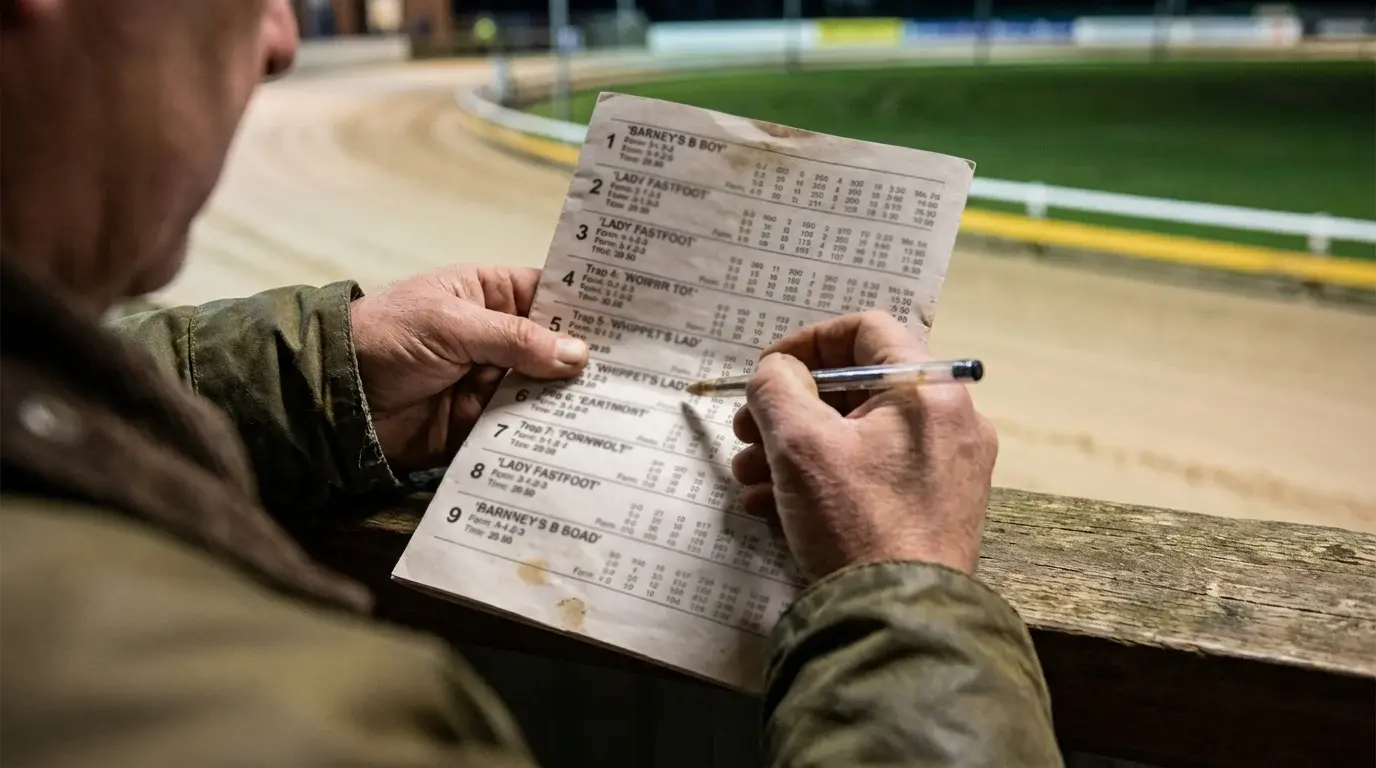
A greyhound's recent form is presented on the race card as a string of finishing positions — 1 3 2 4 1 1, for example — typically covering the last six runs. Reading this string in isolation tells you whether the dog has been competitive, but forecast selection demands a deeper layer. You need to consider the context of each run: which track, what distance, what grade, and against what calibre of opposition.
A dog showing 1 1 3 at A3 grade who is now running in A5 has been competing at a higher standard. That form carries more weight than a string of wins at the current grade against weaker fields. Conversely, a dog dropping from A2 to A4 after a string of poor finishes may be out of form despite theoretically facing easier opposition. For forecast purposes, you want dogs whose recent form suggests they can finish in the top two at this specific grade — not dogs whose headline figures flatter or deceive.
Pay attention to finishing times as well as positions. A dog that finished third but ran a faster time than the winner in its previous outing (possible at different meetings or distances) may have more raw speed than its position suggests. Time comparisons across identical track-and-distance combinations are the most reliable indicator of ability. A consistent performer running 24.20 over 400 metres at Romford is a different prospect from a dog whose times fluctuate between 23.80 and 25.10 — the latter suggests inconsistency that makes forecast prediction unreliable.
Trap Draw and Run Shape
Trap draw is the single most underrated variable in greyhound forecast betting. Each of the six traps produces different run shapes depending on the track geometry, and a dog's effectiveness can swing dramatically based on its draw. A strong railer drawn in Trap 1 at a track with a short run to the first bend is in an ideal position to lead early and maintain the rail. The same dog drawn in Trap 6 faces a wide run into the first turn, potentially losing lengths before the race has properly begun.
For forecast purposes, trap draw analysis becomes particularly valuable when identifying the second-place finisher. The likely winner often receives plenty of market attention, but the runner-up is where analytical edge produces the biggest dividend impact. A dog with solid form drawn in a trap that suits its running style — even if it is not the strongest on raw ability — can represent a strong second-place pick precisely because the market underestimates the trap advantage. Track-specific trap data, available through sites like the GBGB's own results service, shows win and place percentages by trap number at each licensed track. These statistics reveal biases that persist across seasons and inform smarter forecast construction.
Early Pace and First-Bend Position
In six-dog greyhound racing, the first bend is where races are shaped and often decided. The dog that leads into the first turn controls the racing line and avoids the crowding, interference, and checked runs that affect mid-pack and rear runners. For forecast betting, first-bend position is arguably the strongest single predictor of finishing order.
Sectional times — split times recorded at the first bend or at intervals during the race — quantify early pace in a way that overall finishing times cannot. A dog with fast early sections but modest overall times is a front-runner that may tire late; useful as a first-place pick in shorter races, risky in longer ones. A dog with slower early splits but a strong overall time is a closer — less likely to lead at the first bend but capable of finishing strongly. Matching these profiles is at the heart of forecast construction: a fast-breaking front-runner as first, a strong closer as second, for example.
Early pace also interacts with trap draw. Dogs drawn in low traps (1, 2) at tracks with short runs to the bend have the inside line and reach the turn sooner. Dogs in higher traps (5, 6) need early speed to cross and secure position, or they get pushed wide. When evaluating forecast combinations, consider whether your two selections have compatible trap draws that avoid first-bend conflict. Two fast starters drawn adjacently may interfere with each other, compromising both their chances — a scenario that benefits dogs drawn on the opposite side of the track.

Recent Form
Look beyond headline finishing positions. Evaluate grade of opposition, finishing times at identical distances, and consistency of performance over the last four to six runs.
Trap Draw
Match each dog's running style to its trap assignment. Check track-specific trap statistics for win and place percentages that reveal persistent draw biases.
Early Pace
First-bend position is the strongest predictor of finishing order in six-dog fields. Use sectional times to identify front-runners and closers, then construct sequences accordingly.
Running Style
Railers, middle runners, and wide runners interact differently depending on the track and draw. Avoid selecting two dogs whose running styles put them on a collision course at the first bend.
Building a Forecast Betting Strategy
Strategy without discipline is just optimism with a betslip. Building a consistent approach to greyhound forecast betting requires more than good form-reading skills — it demands a structured method for identifying value, managing stakes, and filtering out the races that do not meet your criteria. The punters who profit from forecast betting over months and years are not the ones who bet every race; they are the ones who wait for the right conditions and then act with conviction.
Trap Analysis by Track
Every GBGB-licensed track has its own geometry — different distances, bend radii, run-up lengths, and track surfaces. These physical characteristics produce measurable trap biases that persist across hundreds of races. At some tracks, Trap 1 wins at a rate significantly above the theoretical one-in-six average. At others, wide traps outperform due to a long run to the first bend that neutralises the inside advantage.
For forecast punters, the value in trap analysis lies in identifying the second-place finisher with greater accuracy. The win-bet market generally prices in the strongest dog's chances reasonably well, but the runner-up slot receives far less analytical attention from the betting public. If your trap data shows that Trap 6 at a specific track finishes second at an unusually high rate — perhaps because the wide draw suits closers who pick up places on the final bend — you have a data-driven edge that is not reflected in the forecast price.
Build a reference sheet for the tracks you bet on most frequently. Record trap win percentages and place percentages over a meaningful sample — at least two hundred races per track to smooth out variance. The GBGB results archive and sites like Timeform provide the raw data. Update the sheet periodically, because trap biases can shift when tracks undergo surface maintenance or rail adjustments, though during the current 2026 season the major GBGB circuits have maintained stable configurations.

Spotting Forecast Value
Value in forecast betting exists when the true probability of a specific finishing combination is higher than the market implies. Because forecast dividends are driven by either pool distribution (tote) or the CSF algorithm (bookmaker), pricing inefficiencies emerge in predictable patterns that methodical punters can exploit.
The most common source of forecast value is the under-bet second-place dog. The win market absorbs most of the public's analytical effort, and the forecast market inherits those biases. When a heavily backed favourite wins, the most popular forecast combination is usually the favourite followed by the second-favourite. But form analysis frequently points to a different runner-up — a dog with superior trap draw for the second position, stronger late pace, or a running style that benefits from sitting behind the leader. Backing these less obvious second-place picks generates better forecast dividends because the pool or market has not compressed the price.
Contrarian thinking also applies to the first-place selection. In races where the favourite is marginal — perhaps a short-priced dog whose form does not clearly justify favouritism — opposing the favourite in forecasts can produce outsized returns. The public money backing the favourite deflates forecast dividends for combinations involving it, while simultaneously inflating dividends for combinations that exclude it. If your analysis suggests the favourite is vulnerable, the entire forecast market tilts in your favour.
One practical discipline: set a minimum acceptable dividend before the race. If the projected CSF or tote forecast for your selected combination falls below that threshold, skip the race. This prevents the temptation to back low-value combinations simply because you fancy two dogs. Forecast betting is a volume game played over dozens of meetings, and protecting your bankroll from low-value bets is as important as finding high-value ones.
The average UK greyhound forecast pays between £15 and £40 for a £1 stake — but outliers north of £200 are not uncommon at tracks with smaller pools and open grading, where form is harder to read and fewer punters nail the exact combination.
Tote Forecast or Bookmaker Forecast — Which to Use
Same bet, different machine — and the payout gap can be significant. The choice between placing your greyhound forecast through the tote or through a bookmaker is not merely one of preference. It is a decision that directly affects your return on every winning bet, and the optimal choice varies by race, by meeting, and by the specific combination you are backing.
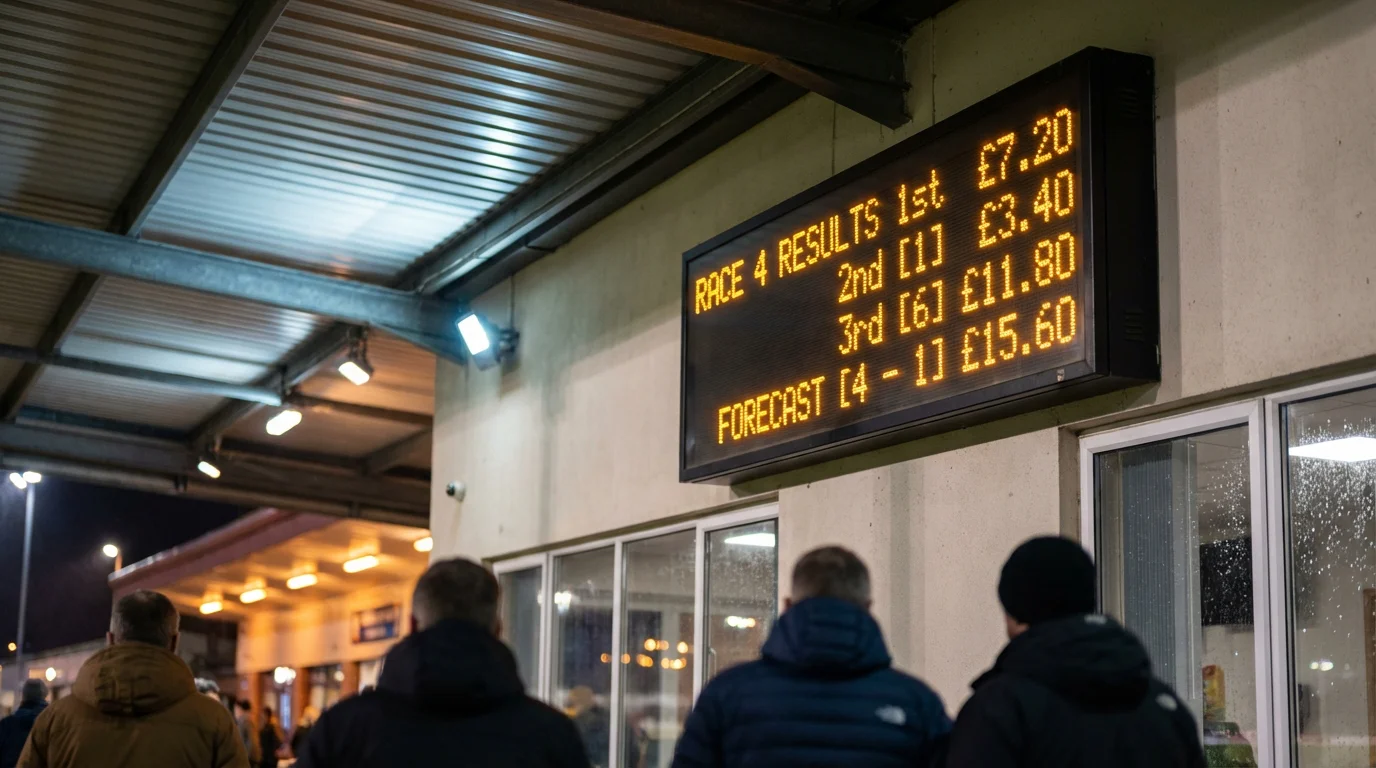
The tote forecast operates on pure pool mechanics. Your return depends on the total money in the forecast pool and how it was distributed. At major meetings with deep pools — a Saturday night at Romford or Nottingham, for instance — tote dividends tend to be stable and broadly similar to CSF returns. At smaller midweek meetings, the pool is thinner, and individual large bets can skew the dividend in either direction. This volatility cuts both ways: you might receive a significantly higher payout than the CSF equivalent, or a lower one. There is no way to know in advance.
The bookmaker forecast, settled at the CSF, offers more predictable returns. Because the CSF is calculated algorithmically from starting prices, it does not fluctuate with pool dynamics. You can estimate your likely return before the race by looking at the current SP odds for your selections — though the final CSF will use the actual SPs at the off, which may drift from earlier prices. Some bookmakers also offer Best Odds Guaranteed (BOG) on greyhound forecasts, meaning if the early price you take exceeds the final CSF, you receive the higher payout. BOG on forecasts is less common than on win bets, but where available, it represents a clear edge for the punter.
A practical approach is to default to the CSF for most races and switch to the tote when conditions favour it — specifically, when you are backing an unfancied combination at a meeting with a healthy pool. The tote punishes popular combinations (because many winning tickets split the pool) but rewards contrarian ones. If your analysis points to an unexpected first-and-second sequence, the tote pool may offer a better dividend than the CSF, because fewer tote punters will be on your combination. Experienced forecast bettors develop a feel for this dynamic over time, but the principle is consistent: tote for contrarian plays at well-attended meetings, bookmaker CSF for everything else.
Non-Runners and Dead Heats in Forecast Bets
Rules exist for the moments when the race doesn't go to plan. Non-runners and dead heats are relatively uncommon in greyhound racing compared to horse racing, but they happen often enough that every forecast punter needs to know how their bet is affected.
When a dog is withdrawn before the race — whether due to injury, illness, or a failed pre-race inspection — the forecast bet rules depend on the timing and the settlement method. Under GBGB regulations, if a dog is withdrawn and a reserve runner takes its place, the race continues as a six-dog event, and your forecast bet stands. Your original selection has been replaced by a different dog, and if that dog was one of your forecast picks, your bet is effectively void on that selection. Most bookmakers will void the entire forecast bet if one of your selected dogs is a non-runner, refunding your stake. The tote handles it similarly: if your selection does not run, the tote forecast bet on that combination is void.
If no reserve is available and the race runs with fewer than six dogs, different rules apply. A five-dog race still supports forecast betting, but the reduced field changes the probability landscape — fewer permutations, shorter dividends. If the race is reduced below the minimum required for forecast betting (which varies by operator but is generally four runners), forecast bets are typically voided entirely.
Dead heats — two dogs crossing the line simultaneously for first or second place — trigger dead-heat rules that divide payouts. For a straight forecast, if your first-place selection dead-heats for first with another dog, your return is halved. If your second-place selection dead-heats for second, the same halving applies. If both your selections are involved in a dead heat at their respective positions, the return is quartered. The mathematics follow standard dead-heat settlement: the full dividend divided by the number of dead-heating dogs at the relevant position.
On the tote, dead-heat forecast dividends are declared after the race and already incorporate the dead-heat deduction. The CSF equivalent is calculated using the dead-heat-adjusted starting prices. In either case, the punter receives a reduced payout rather than a void bet — dead heats settle, they do not cancel. This distinction matters: a dead heat is not a non-runner. Your bet has partially won, and you are entitled to a proportionate return.
One practical implication: in races where two dogs appear very closely matched, factor in the possibility that a dead heat suppresses your dividend. The risk-reward calculation may favour a different combination where the finishing margins are likely to be more decisive.
Greyhound Forecast Questions Answered
What happens to a greyhound forecast bet if one dog is a non-runner?
If one of your selected dogs is withdrawn before the race, most bookmakers void the forecast bet and refund your stake. The same applies to tote forecast bets — your combination is removed from the pool, and the stake is returned. If a reserve runner replaces the withdrawn dog, the race still goes ahead as a six-runner event, but your selection no longer participates. In the rare situation where the race proceeds with a reduced field and no reserve, forecast bets involving the non-runner are voided. The key rule to remember: a non-runner voids; it does not settle as a loser. You get your money back rather than losing the stake.
How is the greyhound forecast dividend calculated?
It depends on where you placed the bet. Tote forecast dividends are pool-based — the total money bet into the forecast pool, minus the operator's takeout (which varies by operator but can reach 34% on Britbet greyhound pools), is divided among winning tickets. The fewer winners, the larger each payout. Bookmaker forecasts are settled using the Computer Straight Forecast (CSF), an algorithm that calculates a standardised return based on the starting prices of the first and second-place finishers. The CSF does not depend on pool size or how many people backed that combination. Both methods can produce different returns on the same result, which is why comparing tote and CSF options before betting is a sound habit.
Is a reverse forecast worth the extra cost compared to a straight forecast?
A reverse forecast doubles your stake to cover both possible finishing orders of your two selections. Whether that extra cost is worthwhile depends on the race. In contests with two closely matched dogs where the finishing order is genuinely uncertain, the reverse forecast is a rational hedge — it protects against the frustration of picking the right pair but the wrong sequence. However, if your analysis gives you genuine directional confidence about which dog finishes first and which finishes second, the straight forecast is more capital-efficient. Routinely defaulting to reverse forecasts without analytical justification halves your return on investment over time.
The Long Game — Why Forecast Betting Filters Out the Noise
Forecast betting isn't a shortcut — it's a filter. It filters out the punters who bet on impulse and rewards the ones who put in the analytical work before the traps open. Every forecast bet is a statement of specificity: you are not just saying a dog will run well, you are predicting how the entire front of the race will unfold. That demand for precision is what makes the returns worthwhile and the losses instructive.
The greyhound racing calendar in the UK runs year-round, and every meeting produces forecast markets. That continuity is an advantage for the disciplined punter. Unlike major horse racing festivals where the once-a-year buzz encourages speculative betting, greyhound forecast markets offer a consistent environment for applying and refining a structured approach. Over weeks and months, the patterns emerge — which tracks produce predictable forecasts, which grades offer the best form reliability, which trap draws repeatedly generate value in the second-place position.
Treat forecast betting as a craft rather than a gamble. Build your process around form reading, trap data, and selective staking. Accept that losing bets are the majority — even the best forecast punters strike at well below 50% — and structure your stakes so that the dividends on winning bets outweigh the accumulated cost of losing ones. The long game is not about finding winners every night. It is about maintaining an edge over a sample size large enough for that edge to compound.
