
How to Read a Greyhound Race Card for Smarter Betting
 Available in US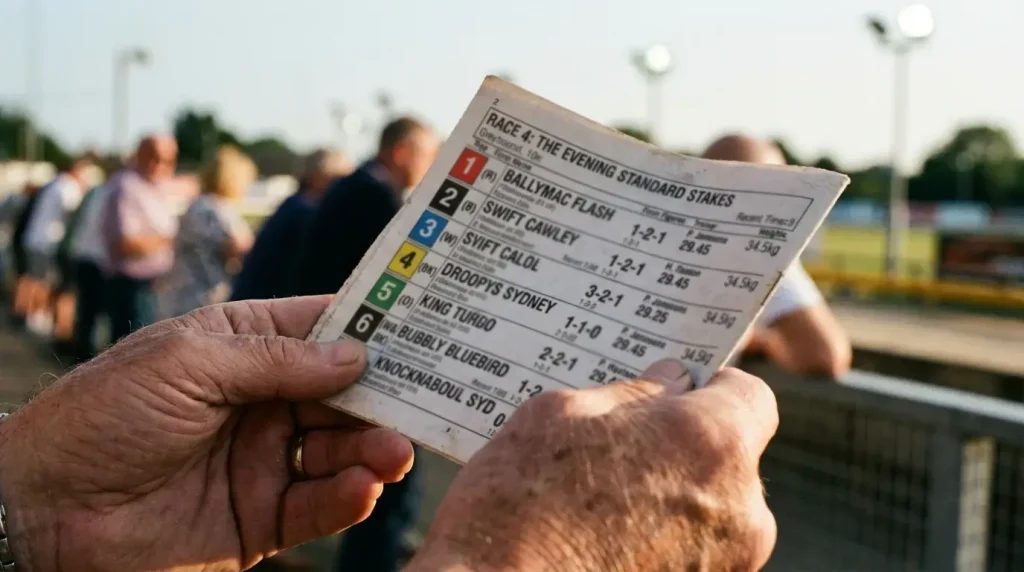
The Race Card Is Your Primary Tool
Every piece of information you need to make an informed greyhound forecast bet is on the race card. The form figures, the times, the trap draw, the grade, the trainer, the dog’s weight and age — it is all there, compressed into a few lines of data per runner. The challenge is not accessing the information; it is knowing which parts to prioritise and how to read them in the context of a forecast bet where you need to identify the first two finishers in order.
This guide walks through a standard UK greyhound race card line by line, explains what each element means, and shows you how to extract the information that actually matters for forecast selection. If you have ever stared at a race card and felt unsure where to start, this is your orientation.
The Layout of a Standard Race Card
A UK greyhound race card presents information for each of the six runners in a structured format. While the exact layout varies between publishers — the Racing Post, Timeform, and individual track cards each have their own style — the core elements are consistent. Here is what you will find for each runner, typically arranged from top to bottom or left to right.
Trap number and colour. The dog’s starting position is listed first, usually with a coloured box or number corresponding to the standard UK trap colours: Trap 1 (red), Trap 2 (blue), Trap 3 (white), Trap 4 (black), Trap 5 (orange), Trap 6 (black and white stripes). The trap number tells you where the dog starts, which directly influences its likely position at the first bend.
Dog name and details. The dog’s racing name, followed by its sex, colour, and age. Sex matters because bitches can be affected by their season, and some race cards note whether a bitch is “in season” or recently returned from a season break. Age is worth noting — greyhounds typically peak between two and four years old. Dogs older than five may be declining, while very young dogs (under two) may be improving rapidly.
Trainer. The name of the kennel that trains the dog. Trainers matter because some kennels consistently produce dogs in peak condition, while others have patchy records. Over time, you will learn which trainers at your preferred track are reliable and which are inconsistent.
Form figures. A string of numbers — typically the last six race results — showing the dog’s recent finishing positions. A form line of 111232 tells you the dog won its last three starts before placing second, third, and second in the three before that. Form figures are the single most consulted piece of data on the card, and rightly so, but they require context to be useful — a string of firsts in A8 grading does not mean the same thing as a string of thirds in A3.
Recent race details. Below or alongside the form figures, most cards list the details of each recent race: date, track, distance, grade, finishing position, winning time (if the dog won) or time behind the winner, and a brief race comment. This expanded view is where the real analytical value sits. A form figure of “4” tells you the dog finished fourth; the expanded line tells you it finished fourth at Romford over 400 metres in A3, beaten two lengths, having been “crowded first bend.” The context transforms the number from a blunt result into a readable story.
Weight. The dog’s racing weight in kilograms. Weight fluctuations between races can indicate fitness changes. A dog that has gained a kilogram since its last run may be slightly less sharp. One that has lost weight may be in peak condition — or may be underweight due to illness. Stable weight across several races is generally a positive sign.
Decoding the Form Figures
Form figures are read right to left: the rightmost number is the most recent result, and each number to its left is progressively older. A line of 321164 means the dog’s last six finishes were (oldest to most recent) 3-2-1-1-6-4. The most recent two or three results carry the most weight — they reflect the dog’s current form, fitness, and confidence level.
Look for patterns rather than isolated results. A dog with form of 111234 is declining — it was winning but has been finishing further back in each successive race. A dog with 654321 is improving — each run is better than the last. A dog with 131214 is inconsistent — it can win but it can also finish poorly, and the forecast selection depends on whether you can identify what determines the good runs (trap draw, distance, track).
The letter codes in form figures carry specific meanings. “F” means the dog fell (rare in flat racing but possible). “T” indicates a trial run, not a competitive race. “R” can mean a reserve run or a refusal to race. A dash or blank usually indicates no recent race at that track. When you see these codes, investigate further — a “T” trial run followed by a competitive entry might indicate a dog returning from injury, which changes the reliability of all preceding form figures.
Form figures from different tracks require caution. A dog that won at Romford over 400 metres is not necessarily the same proposition at Hove over 515 metres. When a dog’s recent form comes from a track other than tonight’s venue, discount it slightly — the track, the distance, the bend profiles, and the competitive standard may all differ.
Times and Grades in Context
Race times on the card are typically listed as the finishing time for the winner, with beaten margins for the other runners expressed in lengths or fractions of a second. A winning time of 29.34 at Romford over 480 metres tells you the race was run at a certain pace — but that number is only useful in comparison to other times at the same track and distance. Times are not directly comparable between tracks because the distances, surfaces, and timing systems differ.
What matters for forecast selection is relative time. Within the current race, which dog has the fastest recent winning time at this track and distance? Which has run the closest to that time in a beaten effort? The dog with the best absolute time is your pace benchmark, and the others are evaluated against it.
Grades add another layer of context. A time of 29.30 in an A2 race is more impressive than 29.30 in an A7 race, because the A2 dog ran that time against faster opposition and was likely pushed harder. When two dogs in tonight’s race have similar recent times but from different grades, the one that ran its time in the higher grade has more in reserve. This dog is a strong forecast candidate because it has demonstrated the ability to run that speed against tougher rivals.
Adjusted times — sometimes called “calculated times” — attempt to account for grade differences and track conditions by normalising all times to a common standard. Timeform publishes adjusted times for greyhound racing, and they are useful for comparing dogs with form from different grades or tracks. If your race card source provides adjusted times, use them in preference to raw times for forecast analysis.
Comments and Symbols
Race comments are the narrative companion to the numerical form. They describe what happened during the race — where the dog was at the first bend, whether it was checked or had a clear run, and how it finished. Common shorthand includes “led first bend” (good early pace), “crowded 2nd bend” (interference), “ran on” (strong finish), “faded” (weakened in the closing stages), and “always behind” (never competitive).
For forecast bettors, the most useful comments are those that explain why a dog finished where it did despite its ability. A dog that finished fourth but was “badly crowded first bend, ran on when clear” is a stronger candidate for the next race than a dog that finished second but “always handy, no extra.” The first dog was unlucky; the second was at its limit. The comment tells you which result was the anomaly and which was the true form.
The Card as Your Compass
The race card contains more information than most punters use. The trap draw tells you the likely first-bend shape. The form figures and expanded race details tell you each dog’s recent ability. The times and grades tell you the competitive standard. The race comments explain the stories behind the numbers. Reading all of these together — not just the form figures in isolation — gives you a complete picture of the race before the traps open. That picture is the basis of every informed forecast bet.
Get more form guides at greyhoundforecast.
Also explore our greyhound form and forecast bets guide.
