
Open Races vs Graded Races: Greyhound Betting Differences
 Available in US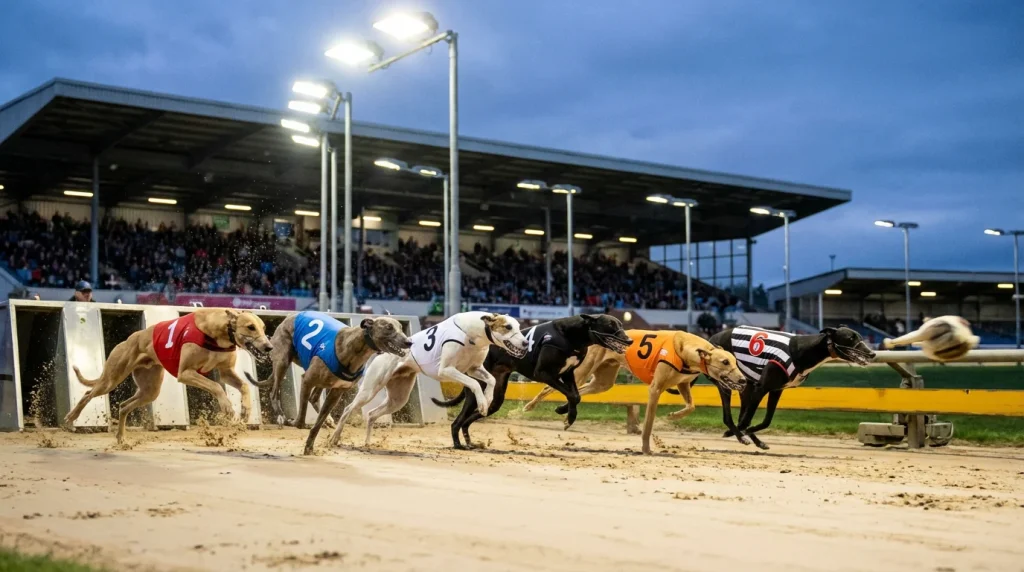
Two Race Types, Two Analytical Challenges
The UK greyhound calendar is built on graded races — routine fixtures where dogs of similar ability compete within a structured ladder. These are the bread and butter of the sport, making up the vast majority of the card at any meeting. Open races, by contrast, are invitation or qualification events that sit outside the grading system. They attract different fields, produce different race dynamics, and demand a different approach from the forecast bettor.
Understanding the distinction is not academic. The way you analyse a graded A5 race at Monday evening’s meeting bears little resemblance to how you should approach an open semi-final on a Saturday night card. The form is sourced differently, the competitive balance is different, and the forecast dividend profile is different. Treating them identically is a common mistake, and it costs money.
Structural Differences
Graded races are assembled by the track’s racing manager based on each dog’s current grade — a rating that reflects its recent race times at that venue. The goal is a competitive field of six dogs with broadly similar ability. A well-graded race produces tight finishes, unpredictable results within a narrow band, and a genuine contest for every finishing position. The grading system acts as a leveller: it compresses the ability range in each race, which makes pure class differences harder to exploit but rewards close analysis of pace, trap draw, and running style.
Open races bypass the grading system entirely. They may be limited to dogs meeting a time standard, or they may be rounds of a knockout competition (heats, semi-finals, finals), or they may be feature events where the racing manager invites specific dogs based on ability. The result is a field that can include dogs from multiple grade levels — an A1 performer alongside an A4 improver, a proven open-race dog next to one making its open-race debut. The ability range is wider, and the class differentials are more pronounced.
The practical effect for bettors: graded races are harder to separate because the dogs are closer in quality, while open races may contain clearer standouts — but those standouts are also more visible to the market, and the prices reflect it. The skill in graded-race forecasts lies in finding small edges among evenly matched dogs. The skill in open-race forecasts lies in correctly assessing whether the class dog justifies its short price, or whether an improver is being underrated.
There is a regulatory distinction too. Open races, particularly feature events, often carry larger prize money and attract higher-quality fields from across the country. Dogs may travel from their home track to compete at a venue they have never raced at, which introduces an additional variable: track unfamiliarity. A dog that has all its form at Romford may run differently on its first visit to Nottingham, regardless of its grade.
Form Reliability
In graded racing, form is your primary tool because the competitive context is consistent. A dog that has been finishing first and second in A4 races at Hove over the past month has a clear, readable form profile. The competition it has beaten (or lost to) is identifiable, the times are comparable, and the race dynamics at that grade level are stable enough to project forward. The grading system creates the conditions for form to be meaningful.
In open racing, form becomes more complex. A dog’s recent graded form may not transfer directly to an open-race context, because the opposition is different — often significantly stronger. A dog that has been dominant in A3 might be meeting A1 dogs for the first time in an open semi-final. Its graded form says it is in peak condition; the open-race context says it has never faced this level of competition. Which signal do you trust?
The answer depends on the degree of class separation. If the class gap between the graded form and the open-race field is large (say, an A5 dog stepping into a field of A1 and A2 runners), the graded form is likely to be irrelevant — the dog is simply not fast enough. If the gap is small (an A3 dog stepping into an open race with A2 and A3 competitors), the graded form retains most of its value because the competitive standard is similar.
Open-race form — results from previous open events, feature races, and knockout rounds — is the gold standard for assessing a dog’s chances in an open race. A dog that has reached the final of a major competition has proven it can handle open-race dynamics: varied fields, high-pressure rounds, and unfamiliar opponents. Dogs with no prior open-race experience are harder to assess, regardless of how impressive their graded form looks.
Forecast Implications
Graded races produce modest forecast dividends when favourites fill the frame and larger dividends when an outsider breaks through. The competitive balance means that outsider-inclusive results are common enough to sustain a profitable forecast approach — you are not always betting on obvious combinations, and the dividends when you find a value angle can be generous.
Open races tend to produce lower forecast dividends on the most likely outcomes because the class dogs are heavily backed. When the two best dogs in the field finish first and second, the CSF is often compressed — £8 to £15 — because the market gave them a strong combined chance. The forecast value in open races comes from the upset: a class dog failing to handle the track, an improver running above its grade, or a pace scenario that disrupts the expected order. These upsets pay well when they occur, because the pool or market has concentrated on the obvious combination.
For combination forecasts, open races are expensive relative to the likely dividend. If two dogs clearly stand out on class, the combination that includes both of them alongside a third selection generates six lines of coverage but only the lines involving both class dogs have a realistic chance — and those lines will pay modestly because the result is expected. In open races, straight or reverse forecasts on the two dogs you genuinely fancy are often more efficient than combinations.
Graded races, by contrast, are natural territory for combination forecasts. The tight competitive balance means that identifying three plausible contenders and covering all pairings is a viable strategy, and the dividends when a non-obvious pair fills the frame can be substantial enough to cover the six-line cost comfortably.
Major Open Events
The pinnacle of UK greyhound racing is the English Greyhound Derby, held annually at Towcester (GBGB). The Derby runs as a multi-round knockout, with heats, quarter-finals, semi-finals, and a final — each round producing open-race fields from qualification. Other major open events include the St Leger at Nottingham, the Cesarewitch, the TV Trophy, and the Essex Vase. These events draw the best dogs in the country and generate the largest betting pools of the greyhound calendar.
For forecast bettors, major open events offer two advantages. First, the pool depth — particularly on tote — means dividends are stable and often generous, even on popular combinations. Second, the volume of information available on each dog is at its highest for these events. Form books, trial times, analyst previews, and expert commentary create a data-rich environment where informed selection has the best chance of producing a positive return.
The rounds leading up to a final are often the best forecast opportunities. Semi-finals tend to produce fields where two or three dogs have a clear class advantage over the rest, making the forecast relatively straightforward. The final itself is the hardest to forecast because the six dogs are the best of the entire competition — the grading effect of successive knockout rounds has compressed the ability range back to the level of a tightly graded race.
Race Type as a Filter
Before you analyse the form, check the race type. Graded races reward patience, close reading of pace and draw, and the acceptance that dividends will often be modest. Open races reward class assessment, track familiarity analysis, and the willingness to back a shorter-priced combination when the evidence supports it. Both race types are forecastable, but the tools and the expectations are different.
If you specialise in graded racing, open events are an occasional change of pace that demands adjusted methods. If you target open racing, graded results are the data source for your open-race analysis — the graded form tells you what each dog can do, and the open-race context determines whether it will do it here.
Find more race guides at greyhoundforecast.
Also read our greyhound grading system and betting.
