
History of UK Greyhound Racing: From Belle Vue to Today
 Available in US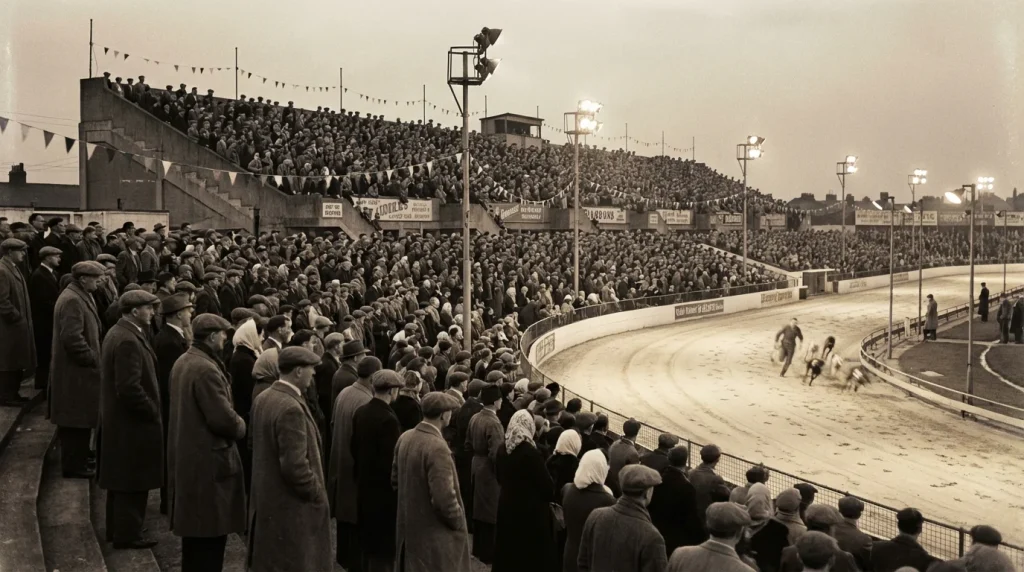
A Century on the Track
Greyhound racing in Britain has a history that stretches back almost exactly a century. From a single meeting at a Manchester stadium in 1926 to a network of licensed tracks across England, Scotland, and Wales, the sport has experienced booms, declines, cultural shifts, and regulatory transformations that have shaped it into what punters encounter today. Understanding that history is not essential for placing a forecast bet, but it provides context for why the sport is structured the way it is — why tracks are where they are, why the grading system works the way it does, and why greyhound racing occupies the specific cultural space it holds in British sporting life.
Origins: Belle Vue and the Birth of Track Racing
Organised greyhound racing with a mechanical hare was an American invention, developed in the early twentieth century as an alternative to coursing — the older sport of chasing live hares across open fields. The mechanical hare, running on a rail around an oval track, allowed greyhound racing to be staged in enclosed stadiums with paying spectators and structured betting. The concept crossed the Atlantic in the mid-1920s, and on 24 July 1926, the first official greyhound meeting in Britain took place at Belle Vue Stadium in Manchester (SIS Racing).
The event was an immediate sensation. Around 1,700 people attended that first meeting (GBGB), drawn by the novelty of the sport and the appeal of affordable, accessible entertainment. By the second meeting, attendance had surged to 16,000. Within months, tracks were opening across the country — White City in London, Hall Green in Birmingham, Wimbledon in south London. By the end of 1927, more than forty tracks were operating in Britain, and greyhound racing had established itself as one of the fastest-growing spectator sports the country had ever seen.
The speed of expansion was driven by two factors. First, greyhound tracks were cheaper to build and operate than horse racing courses, which made them commercially viable in urban areas where land was expensive. Second, evening racing under floodlights gave working-class communities an entertainment option that did not compete with their daytime jobs — unlike horse racing, which ran during working hours and was culturally associated with the upper and middle classes. Greyhound racing was the people’s sport from the beginning.
The early regulatory framework was loose. The National Greyhound Racing Club (NGRC) was established in 1928 to govern the sport (Britannica), but many tracks operated outside its jurisdiction as “flapping tracks” — independent venues with their own rules, their own dogs, and their own betting arrangements. The distinction between licensed (NGRC) and independent tracks persisted for decades and shaped the sport’s reputation and governance.
The Golden Era: 1930s to 1960s
Greyhound racing reached its peak popularity in the years surrounding the Second World War. By the late 1940s, annual attendance across British tracks was estimated at around 70 million (Greyhound Racing UK) — a staggering figure that made greyhound racing one of the most-attended sports in the country, rivalling football. Saturday night at the dogs was a cultural institution in industrial cities from London to Glasgow, combining sport, socialising, and the thrill of the tote.
The betting element was central to the sport’s appeal. The introduction of the totalisator (tote) at greyhound tracks provided a legal, regulated betting mechanism that was simpler and more accessible than the bookmaker system used in horse racing. Punters could bet small amounts on forecast and win pools, collect their dividends at the window, and enjoy an evening’s entertainment for a modest outlay. The tote became synonymous with greyhound racing in a way it never quite achieved in horse racing.
The sport produced genuine stars. Mick the Miller, a brindle greyhound who won the English Greyhound Derby in 1929 and 1930 (GBGB), became the first greyhound celebrity — his exploits covered by national newspapers and his retirement marked by public appearances. Later champions including Ballyregan Bob, who won 32 consecutive races in 1985-86 (Guinness World Records), and Scurlogue Champ kept the sport in the public consciousness through individual brilliance.
The golden era was not without problems. Doping scandals, fixed races, and welfare concerns surfaced periodically, and the sport’s association with working-class gambling attracted moral criticism from social commentators. But through the 1950s and into the 1960s, greyhound racing remained a mass-participation sport with deep roots in British urban culture.
Decline and Closures: 1970s to 2000s
The decline of greyhound racing began in the 1970s and accelerated through the following decades. The causes were multiple and reinforcing. Television brought sport into the home, reducing the need to attend live events. The legalisation of betting shops in 1961 under the Betting and Gaming Act 1960 (legislation.gov.uk) gave punters access to horse racing betting without attending a course, which drew money and attention away from the dogs. Changing leisure habits, rising car ownership (which opened up alternative evening entertainment), and the general decline of urban industrial communities — the sport’s core demographic — all contributed.
Tracks began closing. The economics were brutal: greyhound stadiums occupied large parcels of urban land that were worth far more as housing or retail developments than as sporting venues. White City closed in 1984 (Greyhound Racing History). Wimbledon, the last track in London, finally closed in 2017 (BettingSites.co) after decades of campaigns to save it. Across the country, tracks that had hosted racing since the 1920s were sold, demolished, and built over. The number of licensed tracks fell from 77 at the sport’s peak in the late 1940s — with over 200 additional independent tracks — to around twenty by the 2020s (GBGB).
Each closure eroded the sport’s infrastructure and its cultural visibility. Without a London track, greyhound racing lost its foothold in the capital and its access to the national media. Without local tracks in many cities, communities that had attended the dogs for generations lost their connection to the sport. The decline was not a sudden collapse but a slow attrition — one track at a time, one community at a time.
Regulatory changes accompanied the closures. The NGRC was replaced by the Greyhound Board of Great Britain (GBGB) in 2009 (GBGB), with an expanded mandate covering welfare, regulation, and the promotion of the sport. Welfare standards improved significantly, with mandatory veterinary inspections, injury tracking, and retirement provisions for racing greyhounds becoming standard practice. The sport’s governance became more professional, even as its commercial base was shrinking.
The Modern Era: 2010s to 2026
The greyhound racing that exists today is smaller, leaner, and more professionally run than at any point in its history. Approximately 20 licensed GBGB tracks operate across England, Scotland, and Wales, running regular evening meetings with full tote and bookmaker coverage. The sport is sustained by a combination of on-track attendance, off-course betting (through bookmaker shops and online), and media rights for live streaming.
The shift to online betting has been the most significant change of the last decade. Where greyhound racing was once inseparable from the physical track experience, the majority of greyhound betting now happens through apps and websites. Live streaming through bookmaker platforms means a punter can watch and bet on every GBGB meeting from their phone — an unimaginable development for the sport that built its identity on turnstile crowds and tote queues.
Welfare has become the defining issue of modern greyhound racing. Public attitudes toward animal sports have shifted, and the industry has responded with increased transparency, mandatory reporting of injuries and outcomes, and investment in rehoming programmes for retired racers. Organisations like the Retired Greyhound Trust work to place retired dogs in domestic homes, and the GBGB publishes annual welfare data. These measures have not silenced all criticism — campaigns to ban greyhound racing continue — but they have modernised the sport’s approach to the dogs that run in it.
The betting product has adapted too. Forecast and tricast betting remains central to the greyhound experience, and the introduction of CSF settlement, online tote access, and data-rich race cards has made the analytical side of greyhound betting more accessible than ever. The punter in 2026 has more information, more tools, and more choices than any generation of greyhound bettors before them.
The Sport Endures
British greyhound racing in 2026 is a fraction of the size it was in its golden era, but it is not a dying sport — it is a changed one. The tracks that remain are well-run, the dogs are well-cared-for, and the betting markets are active. The crowds are smaller, but the punters who attend are committed, knowledgeable, and engaged. The sport has lost its mass-market status but retained its core appeal: six dogs, six traps, thirty seconds of racing, and the challenge of predicting who crosses the line first.
For the forecast bettor, the sport’s long history matters because it built the infrastructure — the grading system, the tote, the Tattersalls Rules, the track designs — that governs every race you bet on today. The traps open the same way they did at Belle Vue in 1926. The dogs still chase the hare. And the punter still tries to name the first two home.
Learn more about the sport at greyhoundforecast.
Also read our best UK greyhound tracks for forecast betting.
