
CSF Explained: Computer Straight Forecast in Greyhound Racing
 Available in US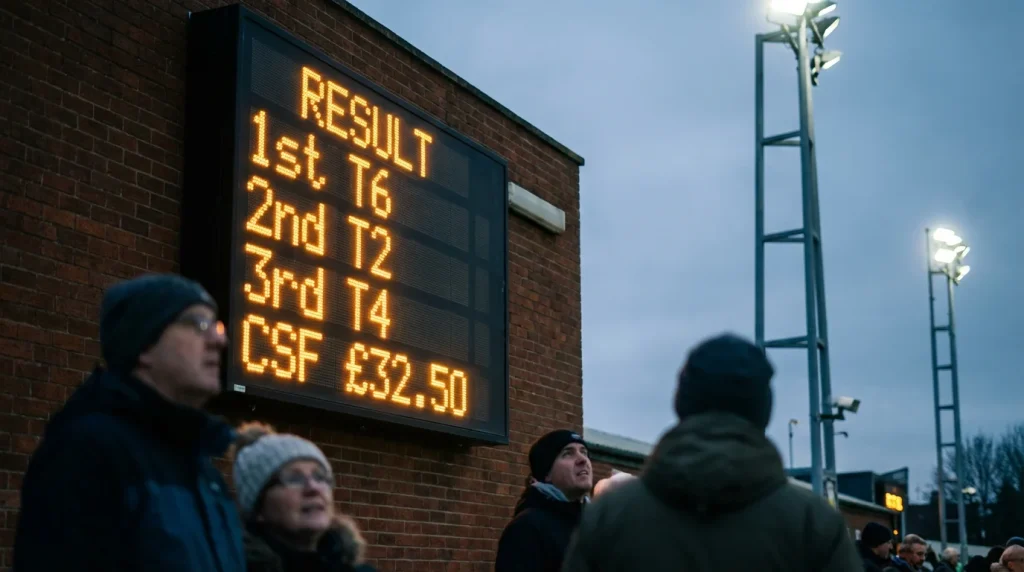
The Formula Behind Your Return
Every time you place a forecast bet with a bookmaker and the bet is settled at starting price, the number that determines your payout is the Computer Straight Forecast — the CSF. It is not an odds price that you can see before the race. It is not a pool dividend shared among winners. It is a calculated figure, generated after the race by a formula that takes the starting prices of the first and second-placed runners and produces a dividend per £1 staked. Understanding what drives that number — and why it varies so widely from race to race — gives you a more realistic view of what forecast betting actually pays and where the genuine value sits.
The CSF is the standard settlement mechanism for off-course forecast bets across UK greyhound and horse racing. If you have ever placed a greyhound forecast through an online bookmaker and seen a return posted after the race, that return was almost certainly calculated using the CSF formula. This article explains what the CSF is, how it works, how it compares to the tote forecast dividend, and what typical ranges look like across UK greyhound racing.
What the CSF Is
The Computer Straight Forecast is a mathematical formula that calculates the fair return for correctly predicting the first two finishers of a race in the correct order. It was introduced to replace manual forecast calculations and to provide a standardised, repeatable settlement method that bookmakers and punters could both rely on.
The CSF is administered centrally and applies uniformly across all licensed bookmakers. This means the CSF dividend for a given result is the same regardless of which bookmaker you placed the bet with — unlike win bets, where different bookmakers may offer different prices. When a bookmaker settles a forecast at CSF, they are all using the same number.
The inputs to the CSF are the official starting prices (SPs) of all runners in the race, with particular weight given to the SPs of the first and second-placed finishers. The formula also accounts for the number of runners and the overall shape of the market. The exact algorithm is proprietary — it is not published in full — but its behaviour is well understood through decades of observed results.
One common misconception is that the CSF is simply the first dog’s SP multiplied by the second dog’s SP. It is not. The relationship between SPs and the CSF is more nuanced than a straight multiplication. A 2/1 winner followed by a 5/1 second does not produce a CSF of 15.0 (which would be the product of 3.0 x 5.0 in decimal odds minus adjustments). The actual CSF in that scenario would typically be lower — perhaps £10 to £14 — because the formula accounts for the probability distribution across the entire field, not just the two placed dogs.
How the CSF Is Calculated
While the exact proprietary formula is not publicly available, the CSF follows a well-established statistical framework. The calculation takes the implied probabilities of all runners (derived from their starting prices), normalises them to account for the bookmaker’s overround, and then computes the joint probability of the specific first-and-second outcome that occurred.
In simplified terms, the CSF asks: given the market’s assessment of each dog’s chances, how likely was this specific finishing order? The less likely the outcome, the higher the dividend. The more likely the outcome, the lower the dividend. This is why a forecast with two favourites filling the top two spots pays modestly, while a forecast involving an outsider pays significantly more — the market rated the outsider’s chances of finishing in the top two as low, and the CSF reflects that assessment.
The overround — the built-in bookmaker margin in the starting prices — also affects the CSF. When the overround is high (meaning the SPs collectively imply a market total well above 100%), the CSF tends to be slightly lower, because the implied probabilities are inflated. When the market is tight (closer to 100%), the CSF tends to be slightly higher. In practice, UK greyhound markets typically run at overrounds of 115-130%, which is factored into the calculation as a standard condition.
The number of runners matters as well. In a standard six-dog greyhound race, the number of possible forecast outcomes is 30 (6 x 5). In a five-dog race (after a non-runner with no reserve), the number drops to 20 (5 x 4). Fewer possible outcomes mean that any given outcome is more probable, which pushes the CSF down. A five-dog race with the same SPs as a six-dog race will produce a lower CSF dividend, because the missing runner’s probability has been redistributed among the remaining dogs.
Some bookmakers publish a “CSF table” or reference guide that gives approximate CSF dividends for common SP combinations. These are useful for pre-race estimation but are not exact, because the table cannot account for the specific overround and field composition of each individual race. Treat them as guidelines, not guarantees.
CSF vs Tote Forecast Dividend
The CSF and the tote forecast dividend settle the same bet — the first two finishers in order — but they are driven by different forces. The CSF is driven by the starting prices of the runners. The tote dividend is driven by the distribution of stakes in the forecast pool. These two forces usually produce similar numbers, but they diverge in predictable ways.
When the winning combination is popular — backed by a large proportion of the forecast pool — the tote dividend falls below the CSF. The pool is shared among many winning tickets, diluting the return. In the same scenario, the CSF is unaffected by how many people backed the combination; it cares only about the SPs.
When the winning combination is unpopular — an outsider in the frame, or an unusual trap pairing — the tote dividend can exceed the CSF, sometimes significantly. Fewer winning tickets means each one receives a larger share of the pool. The CSF, calculated from SPs, may not fully capture the extent of public neglect for that combination.
The commission structure also creates a baseline difference. The tote deducts approximately 29.9% from the forecast pool before paying out. This commission suppresses the tote dividend relative to the CSF, all else being equal. For the tote to outperform the CSF, the combination must be unpopular enough to overcome the commission drag — which happens regularly on unusual results but rarely on obvious ones.
A practical rule: if you are backing a straightforward, form-supported forecast where both dogs are well-fancied, the CSF is likely to return more than the tote. If you are backing a contrarian combination that the public has overlooked, the tote may offer the better payout. Neither is always superior — the right choice depends on the specific bet and the specific pool.
Typical CSF Ranges in UK Greyhound Racing
Across UK graded racing, CSF dividends typically fall into recognisable bands based on the prices of the placed dogs.
When both placed dogs are short-priced (SP of 2/1 or less), the CSF usually sits between £4 and £12 per £1 stake. These are the bread-and-butter results of graded greyhound racing — the favourite and second favourite filling the frame in the expected order. The returns are modest, and for combination forecasts costing £6, these dividends often produce a net loss even when the selection is correct.
When one placed dog is short-priced and the other is a mid-range outsider (SP of 4/1 to 8/1), the CSF typically ranges from £15 to £45. This is the productive zone for forecast punters — the dividends are large enough to produce meaningful profit on straight and reverse forecasts, and they represent the type of result that strong form analysis can consistently identify.
When a genuine outsider (SP of 10/1 or above) features in the first two, the CSF can climb past £50 and occasionally past £100. These are the results that make forecast betting profitable in the long run, even though they occur less frequently. A single £80 CSF on a £1 straight forecast wipes out a long run of losing bets and puts you in profit.
Tricast CSFs (for the first three finishers in order) operate on the same principles but at higher magnitudes. Typical tricast CSFs in UK greyhound racing range from £30 to £500, with outliers in the thousands. The wider range reflects the additional difficulty and the lower probability of any specific three-dog order occurring.
Beyond the Number
The CSF is a settlement tool, not a prediction tool. It tells you what a forecast paid after the race, not what it will pay before it. But by understanding the drivers — starting prices, field size, overround — you can develop an intuitive sense of the dividend range your selection is likely to produce if it wins. That intuition allows you to assess whether the potential return justifies the stake, which is the fundamental decision in every forecast bet.
Over time, tracking CSF dividends against your own selections builds a personal database of what your forecast style actually pays. Some punters naturally gravitate toward favourite-heavy forecasts with modest CSFs. Others target the outsider-inclusive combinations that produce larger dividends but hit less often. Neither approach is wrong, but each demands a different staking plan and a different expectation of results. The CSF is the mirror that shows you which type of forecast bettor you are — and whether your staking matches your style.
Find more forecast guides at greyhoundforecast.
Also explore our straight forecast greyhound betting guide.
