
Greyhound Trainer Form: How Kennels Affect Betting Value
 Available in US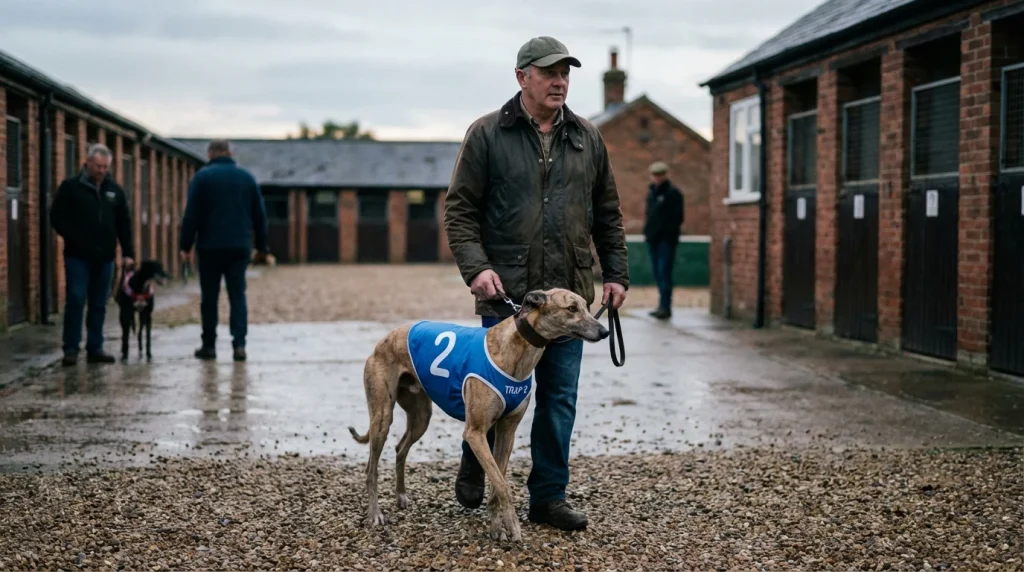
The Name Above the Dog
Every greyhound on the race card has a trainer listed alongside its name, trap number, and form figures. Most punters glance at it and move on. That is a missed opportunity. Trainers in greyhound racing play a role that is closer to a football manager than a horse racing handler — they control the preparation, the nutrition, the trial regime, and the strategic placement of each dog in their kennel. Two dogs with identical form figures running from the same trap can be very different propositions if one comes from a kennel that consistently produces dogs in peak condition and the other comes from one that does not.
Trainer form does not override dog form, but it provides context that the raw numbers cannot capture. This article explains what trainers actually do, how to evaluate their track records, and how to use kennel form as a practical input for greyhound forecast selection.
What the Trainer Actually Does
A greyhound trainer is responsible for the dog’s physical condition, racing fitness, and competitive programme. This includes feeding, exercise, trialling, injury management, and deciding which meetings and grades to target. The trainer works with the racing manager at each track to place their dogs in appropriate races, and the quality of that placement — matching the dog to the right grade, distance, and field — directly affects results.
Good trainers do several things consistently. They present their dogs in peak physical condition on race night. They trial dogs at the track before competitive entries so the dog is familiar with the bends, the surface, and the hare. They manage the racing programme so dogs are not over-raced (which leads to fatigue and declining form) or under-raced (which leads to ring-rust and unpredictable performances). And they communicate honestly with the grading team about their dog’s readiness, which produces more competitive fields and more meaningful form.
The difference between a well-managed kennel and a poorly managed one is visible in the results over time. Kennels that consistently produce dogs running near their best times, hitting the frame regularly, and improving through the grades are doing something right in their preparation. Kennels where dogs frequently run below par, show erratic form, or fail to progress as expected may be suffering from issues in training, nutrition, or race management that the punter cannot see but can infer from the pattern.
Evaluating Kennel Form
Kennel form is assessed the same way dog form is — through results data over a meaningful sample period. The metrics to track are: win percentage (what proportion of the kennel’s total runners win), place percentage (first or second), and average finishing position. A kennel with a win rate above 20% across all its runners is performing well above average. One sitting at 12-15% is competitive. Below 10% suggests systemic issues.
Track-specific kennel form is more useful than aggregate data. A trainer based near Romford whose dogs race primarily at Romford will have a strong home-track advantage — familiarity with the surface, the grading, and the competition. The same trainer’s dogs racing at Towcester for the first time may perform below expectations simply because the travel, the unfamiliar track, and the different racing dynamics all work against them.
Seasonal form matters for many kennels. Some trainers have dogs that peak in summer, when the warmer conditions and firmer surfaces suit their preparation methods. Others perform better in winter. Track these patterns over a full calendar year, and you will find that certain kennels have predictable seasonal rhythms that can inform your forecast timing — entering a dog from a summer-peaking kennel in your December forecast is less confident than backing the same dog in July.
Recent kennel form — the last two to four weeks — is the most actionable metric. A kennel that has been hitting winners regularly across its recent runners is in a good patch, and the next runner from that kennel benefits from the inference that the preparation and placement are currently on point. Conversely, a kennel going through a cold spell may indicate a wider issue — a change in feed supplier, a kennel illness, a disruption in routine — that affects all its dogs, not just the one whose form you are studying.
Some data services track kennel form as a standard feature. Timeform includes trainer statistics in its analysis, and the Racing Post publishes trainer records that can be filtered by track, period, and distance. These tools save you the work of compiling the data manually, though maintaining your own kennel notes for your preferred track remains the most reliable approach.
Seasonal Patterns
Greyhound trainers operate on seasonal cycles that are less pronounced than in horse racing but still detectable. The major competition calendar — with the English Derby in the summer and the St Leger in the autumn — means that top kennels often prepare their best dogs to peak around these events. Dogs from these kennels may run slightly below their best in the months before a major target as the trainer conserves the dog’s energy and sharpness for the competition rounds.
Bitches add another seasonal layer. Seasons (heat cycles) occur roughly every six months and can take a bitch out of competition for several weeks. Trainers manage this by timing the bitch’s return to racing carefully, often with a trial or two before competitive entries. A bitch returning from a season break may need one or two runs to regain race fitness, and the forecast bettor should treat the first run back with caution regardless of how strong the pre-season form was.
Winter racing presents its own challenges for kennels. Cold weather, harder surfaces, and shorter days affect training routines. Some kennels adapt well and maintain consistent output through the winter months. Others see a dip in results from November to February. Tracking which kennels handle the winter effectively is a simple but underused edge — it requires only that you compare kennel strike rates between summer and winter and note the discrepancies.
Trainer-Track Specialisms
Most UK greyhound trainers are based within travelling distance of one or two tracks and race their dogs primarily at those venues. This creates natural specialisms: a trainer based near Hove will know the track intimately, have relationships with the grading team, and understand which of their dogs suit the specific bend profiles and distances available there. Their home-track results will be stronger, on average, than their away-track results.
This specialism is exploitable for forecast bettors. When you see a trainer’s dog entered at their home track, the probability that the dog runs to its ability is higher than when the same dog travels to an unfamiliar venue. The trainer has trialled the dog at the track, knows the surface, and has placed it in a grade that reflects its true standard at that venue. When the same trainer sends a dog to a different track for a feature event, there is more uncertainty — the dog may handle the change, or it may not, and the trainer’s advantage is reduced.
At your preferred track, build a mental (or written) shortlist of the three or four trainers who consistently perform well there. Their runners deserve slightly more credit in your forecast analysis than runners from less established kennels. This is not a blind rule — a poor dog from a good trainer still loses — but it is a weighting that reflects the reality of how kennel quality influences race-night performance.
The Handler Factor
Trainer form is the softest edge available in greyhound forecast betting — it is real but subtle, and it should never override strong form or clear pace data. Its value lies in the margins: when two dogs are equally matched on form and draw, the one from the better-performing kennel has a marginal advantage. When a dog’s recent form has been poor but the kennel’s overall form has been strong, the dog may be a better prospect than its individual form suggests. These are small adjustments, not wholesale changes to your analysis, but small adjustments are exactly what separates profitable forecast punters from break-even ones.
Get more form guides at greyhoundforecast.
Also explore our greyhound form and forecast bets guide.
