
Virtual Greyhound Racing Forecasts: How Virtual Dog Bets Work
 Available in US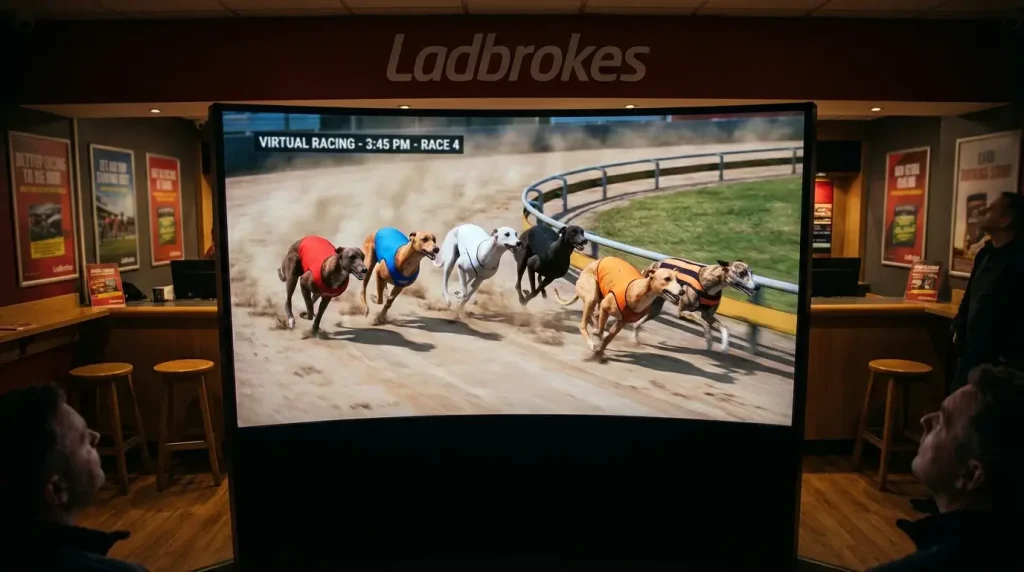
A Different Kind of Race
Virtual greyhound racing looks like the real thing — six dogs, numbered traps, a running commentary, a finish line. The graphics have improved to the point where a casual glance might not immediately distinguish a virtual race from a low-resolution stream of a live meeting. But beneath the animation, the mechanics are fundamentally different. There are no real dogs, no form to study, no trap draws influenced by track geometry, and no weather to account for. The result is determined by a random number generator before the visual race even begins.
This changes everything about how forecast betting works. In live greyhound racing, the forecast bettor has an informational edge — form, pace, draw, conditions — that can produce a positive expected return over time. In virtual racing, there is no information to exploit. The edge belongs entirely to the operator, and the bettor is playing against fixed mathematical margins. Understanding this distinction is essential before placing a single virtual forecast bet.
How Virtual Greyhound Racing Works
Virtual greyhound races are produced by software companies such as Inspired Entertainment, Kiron Interactive, and others that supply virtual sports content to licensed bookmakers. Each race is generated by a random number generator (RNG) that determines the finishing order before the animation renders. The visualisation — the dogs running, the commentary, the photo finish — is cosmetic. It illustrates a pre-determined result rather than depicting a real competition.
Races run continuously, typically every two to four minutes, and are available around the clock. There is no meeting schedule, no seasonal break, and no limit to the number of races per day. Each race is independent — the result of one race has no bearing on the next, because the RNG resets for every event. There is no form, no improving or declining dogs, and no pattern to discover. The output is random within the parameters set by the software.
The virtual dogs are assigned numbers and sometimes names, but these are cosmetic labels. Virtual Trap 1 does not have a running style. Virtual Trap 6 does not have a trap bias. The numbers are identifiers for the betting market, not representations of real animals with trackable attributes. Any patterns a punter believes they have spotted in virtual results are coincidental — the product of seeing structure in randomness, which human brains are exceptionally good at doing and which is exceptionally misleading in this context.
The odds for each virtual runner are set by the software or the bookmaker and reflect the built-in margin. The sum of implied probabilities exceeds 100%, and the difference is the operator’s profit margin — typically 15-20% on virtual greyhound products, which is higher than the margin on most live racing markets. The odds do not reflect any underlying reality because there is no underlying reality to reflect. They are a mathematical construct designed to produce a consistent return for the operator.
RNG and the Odds Structure
The RNG in virtual greyhound racing is certified by independent testing labs to ensure genuine randomness. In the UK, virtual racing products offered by licensed bookmakers are regulated by the Gambling Commission and must meet technical standards for fairness. This means the RNG genuinely is random — no dog is programmed to win more often than its odds suggest, and no pattern exists to exploit.
The odds structure typically assigns one or two dogs as “favourites” with shorter prices and the rest as progressively longer-priced outsiders. This mirrors the shape of a real racing market and makes the product feel familiar to punters accustomed to live racing. But the favourites in a virtual race are not more likely to win because they are better dogs — they are more likely to win because the RNG has been parameterised to produce outcomes roughly in line with the published odds. The favourite wins approximately as often as its price implies, minus the operator’s margin.
For forecast bets, the virtual odds structure means the most likely combinations — the two shortest-priced dogs finishing first and second — pay the least, while outsider-inclusive combinations pay more. This mirrors live racing payouts in structure but not in substance. In live racing, you can assess whether the favourite deserves its price by studying its form. In virtual racing, the favourite’s price is a statement of designed probability, not an assessment of ability that you can second-guess.
The operator’s margin on virtual forecasts is generally higher than on virtual win bets because the number of possible outcomes is larger and the public’s ability to handicap each combination is nonexistent. A virtual forecast market with a 30 possible outcomes and a 20% operator margin means that, on average, for every £100 staked on virtual forecasts, £80 is returned to bettors. This is a worse proposition than live greyhound forecast betting, where a skilled punter can achieve a positive expected return through form analysis.
Forecast Betting in Virtual Racing
Virtual greyhound forecasts are available at most bookmakers that offer virtual racing. The bet types mirror live racing: straight forecast, reverse forecast, and combination forecast. Settlement is typically at fixed virtual odds calculated by the software rather than at CSF, because there are no starting prices in the traditional sense — the odds are the odds, determined by the algorithm.
The returns on virtual forecasts tend to be lower than equivalent live racing CSF dividends. The operator’s higher margin on virtual products compresses the payouts. A virtual forecast involving two mid-priced runners might return £12-£18 per £1 stake, whereas a similar live racing result could produce a CSF of £20-£30. The difference is the margin, and it is consistent across virtual products.
Because there is no form to analyse, every virtual forecast is effectively a random guess with known odds. You can calculate the expected return for each combination by multiplying the implied probability of that combination winning by the offered payout. In almost every case, the expected return is negative — which is how the operator generates profit. There is no strategy, no system, and no analytical approach that changes this fundamental reality.
Real vs Virtual: The Key Differences
The differences between live and virtual greyhound forecast betting can be summarised in one sentence: live racing has information; virtual racing has none. In live racing, the form card, the trap draw, the running style, the conditions, and the grading all provide data that the informed punter can use to make selections with a positive expected return. In virtual racing, the result is random, the odds include a significant margin, and no amount of analysis can shift the expected return above zero.
This does not mean virtual greyhound racing is dishonest or rigged. The RNG is genuinely random, and the published odds reflect the designed probabilities accurately. The product does what it says — it generates random race outcomes within a specific probability framework. The issue is not fairness but edge: the punter has none. In live racing, skill matters. In virtual racing, it does not.
There is also no variance profile to manage in the same way. Live forecast betting involves long losing runs punctuated by large dividends, and the skilled punter can achieve a positive return over hundreds of bets. Virtual forecast betting involves the same long losing runs, but the positive return never materialises because the maths does not support it. The operator’s margin guarantees that, over a large sample, the virtual bettor loses the margin — reliably and predictably.
Virtual Racing as Entertainment
Virtual greyhound racing exists as an entertainment product, and there is nothing wrong with treating it as such. The races are fast, the betting is instant, and the product is available when live racing is not. If you enjoy the experience and set a strict entertainment budget — separate from your live racing bankroll — virtual forecasts can be a harmless diversion.
The problems begin when virtual racing is treated as a substitute for live racing or, worse, as a way to recover losses from live betting. The continuous availability of virtual races (every few minutes, 24 hours a day) creates a temptation to chase losses that does not exist in live racing, where the card ends and the next meeting is hours or days away. If you find yourself placing virtual forecasts to fill gaps between live races, or increasing stakes on virtual bets to make up for a bad evening on the live card, stop. The maths is not on your side, and the availability of the product is designed to encourage exactly this behaviour.
Keep virtual separate from live. Budget it independently. And never apply the analytical tools of live forecast betting — form, pace, draw, conditions — to a product where they have no relevance. The dogs are not real, the races are not real, and the only real thing is the money you stake.
Find more racing guides at greyhoundforecast.
Also read our greyhound forecast betting online.
