
Wide Runners vs Railers: Forecast Betting by Running Style
 Available in US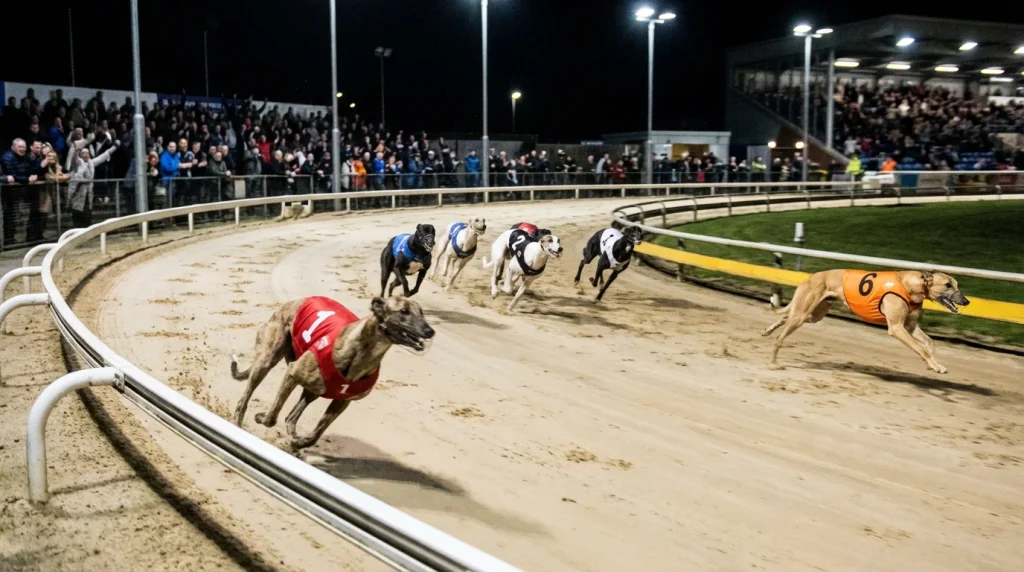
Running Lines and Finishing Order
Every greyhound has a preferred running line. Some hug the inside rail, saving ground on every bend. Others drift wide, taking the longer route but avoiding the traffic that builds up along the fence. A third group runs through the middle, splitting the difference. These running styles are not cosmetic preferences — they are deeply ingrained patterns that affect where a dog finishes, how it interacts with the rest of the field, and how the race unfolds from the first bend onward.
For forecast bettors, running style is the variable that connects trap draw to finishing position. Knowing whether a dog is a railer, a wide runner, or a middle runner tells you how it will navigate the bends, where it will be relative to other dogs at key points in the race, and — critically — which other dogs it is most likely to interfere with or avoid. The forecast that pairs a clean-running railer with a wide runner who avoids trouble on the outside is a fundamentally different proposition from the one that pairs two middle runners likely to crowd each other through the second bend.
This article defines the three main running styles, explains how each affects forecast outcomes, and identifies the style combinations that produce the most predictable results.
Running Styles Defined
Railers are dogs that naturally run along the inside rail. They take the shortest path around each bend, covering the minimum distance from start to finish. At their best, railers break fast from an inside trap, grab the rail at the first bend, and hold it all the way to the line. They are efficient runners — but they are also vulnerable to crowding. If a railer gets bumped off the rail at the first bend, it often loses multiple lengths trying to regain its preferred line, and its race is effectively over.
Railers perform best from Traps 1 and 2, where the distance to the inside rail is shortest. A railer drawn in Trap 5 or 6 faces a diagonal run across the field to reach the rail, which is slow and risky. When you see a confirmed railer drawn wide, discount its chances significantly — the trap draw conflicts with the running style, and the race is working against the dog before it leaves the boxes.
Wide runners take the outside route around bends, staying clear of the rail and the congestion that typically forms along it. They cover more ground than railers but gain the advantage of clear running — no dogs to check their stride, no bumping at the bends. Wide runners tend to finish strongly because they maintain momentum through the turns while inside dogs are checking and adjusting.
Wide runners perform best from Traps 5 and 6, where they can swing wide immediately without having to navigate across the field. A wide runner drawn in Trap 1 faces an awkward choice: run the rail (against its nature) or try to get wide early (losing ground). The same logic that penalises a railer from an outside draw applies in reverse — a wide runner from an inside draw is fighting its own instincts.
Middle runners are dogs that run between the two extremes, typically one or two lanes off the rail. They are the most versatile but also the least predictable. Middle runners can adapt to their draw more easily than strict railers or wide runners, but they are also more susceptible to interference because they occupy the space where the most crowding occurs — particularly at the bends, where railers push out and wide runners cut in.
How Running Style Affects Finishing Position
The relationship between running style and finishing position is mediated by the bends. Every UK greyhound track has at least two significant turns, and these are the moments where running style determines whether a dog gains ground, loses ground, or holds position.
Railers on the rail gain ground on every bend. The inside route is geometrically shorter, and a dog that holds the fence saves roughly one to two lengths per turn compared to a wide runner. Over two bends, that advantage compounds to two to four lengths — a significant margin in a race that might be decided by half a length. This is why railers from inside traps are such strong first-place candidates: they combine ground efficiency with positional control.
Wide runners sacrifice ground on the bends but gain something equally valuable: a clear run. A wide runner that swings out at the first bend avoids the inevitable congestion along the rail, maintains its stride pattern, and often finishes the race running faster than its rivals because it has not been checked or bumped. Wide runners frequently close strongly in the home straight, picking up beaten dogs that lost momentum at the bends. This makes them excellent second-place candidates in forecast bets — they may not lead, but they run on reliably.
Middle runners are the wildcards. When they get a clean trip — no bumping, no checking — they can finish anywhere in the field. When the race is rough and the bends are contested, middle runners are often the ones caught in traffic, and they finish below their ability. For forecast selection, middle runners are higher variance than railers or wide runners. They can be the right pick in a race with a clear pace shape, but they are risky in races where the first-bend order is uncertain.
The most predictable forecast outcomes tend to involve dogs running their preferred style from their preferred draw. A railer drawn in Trap 1 who leads at the first bend and a wide runner drawn in Trap 6 who avoids trouble and finishes strongly is a classic forecast pairing that repeats across UK tracks with regularity.
Best Style Combinations for Forecast Bets
Certain running-style combinations produce more reliable forecast results than others. The strongest pairing is a front-running railer as your first selection and a wide runner as your second. The railer controls the race from the front, the wide runner runs clear of traffic and finishes into second, and the two dogs occupy different parts of the track — meaning they are unlikely to interfere with each other. This is the lowest-variance forecast you can construct, because each dog is running its own race independently of the other.
The second-strongest pairing is two railers from adjacent inside traps — say Trap 1 and Trap 2. If both dogs break well and the one from Trap 1 grabs the rail, the dog from Trap 2 often settles in second and holds that position. The risk here is that the two dogs contest the rail at the first bend and check each other, allowing a wide runner or middle runner to capitalise. This pairing works best when one railer is clearly faster out of the traps than the other, so the pecking order is established before the bend rather than during it.
The weakest combination for forecast reliability is two middle runners. Both dogs will be competing for the same space through the bends, and the likelihood of interference is high. When you identify a race where the two most fancied dogs are both middle runners drawn in Traps 3 and 4, consider the possibility that their proximity will cause both to underperform — and that the value forecast might involve a railer or wide runner that avoids the trouble entirely.
One underrated combination is a wide runner first, railer second. This happens less frequently because railers tend to lead more races than wide runners, but when a wide runner has the pace to lead from an outside trap and a railer is drawn inside with slightly less early speed, the wide runner can swing to the front while the railer picks up the pieces along the rail. The two dogs run on different lines, and the forecast lands with both runners having had a clear trip.
Track-Specific Effects on Running Style
Track geometry amplifies or dampens the running-style effect. At tracks with tight bends — Monmore, for example — the rail advantage is magnified, and railers drawn inside have a pronounced edge. At tracks with wide, sweeping bends — Towcester, Nottingham — wide runners are less penalised by the extra ground, and the gap between railer and wide runner finishes narrows.
Sprint distances (typically 240-280 metres) favour early-pace railers because there is only one significant bend and the race is essentially over by the time the field hits the back straight. Middle distances (460-500 metres) offer more opportunity for wide runners and closers to make up ground over two or more bends. Longer distances (640 metres and above) tend to neutralise the running-style advantage because the field spreads out and the congestion that hurts middle runners dissipates over the extra ground.
When specialising in a particular track for forecast betting, learn how that track treats each running style. Some tracks are railer-friendly, some are wide-runner-friendly, and a few are genuinely neutral. This knowledge, combined with an awareness of each dog’s preferred line, gives you a structural edge that pure form analysis misses.
The Running-Style Shortcut
Running style is recorded on most race cards, either as an explicit note (R for railer, W for wide, M for middle) or inferrable from race comments. When you are short on time and need a quick forecast filter, running style plus trap draw gives you more predictive power per minute of analysis than almost any other variable. A railer from Trap 1 paired with a wide runner from Trap 6 is a structurally sound forecast that requires no deeper analysis to justify — and over time, it wins more often than random selection or market-following.
It is a shortcut, not a substitute. But on a busy card with twelve races, the punter who can identify favourable style-draw combinations in thirty seconds per race will find more viable forecasts than the one who spends five minutes on pure form analysis and runs out of time before the off.
Get more race analysis at greyhoundforecast.
Also read our trap draw bias in greyhound forecasts.
