
Early Pace in Greyhound Racing: Key to Forecast Selection
 Available in US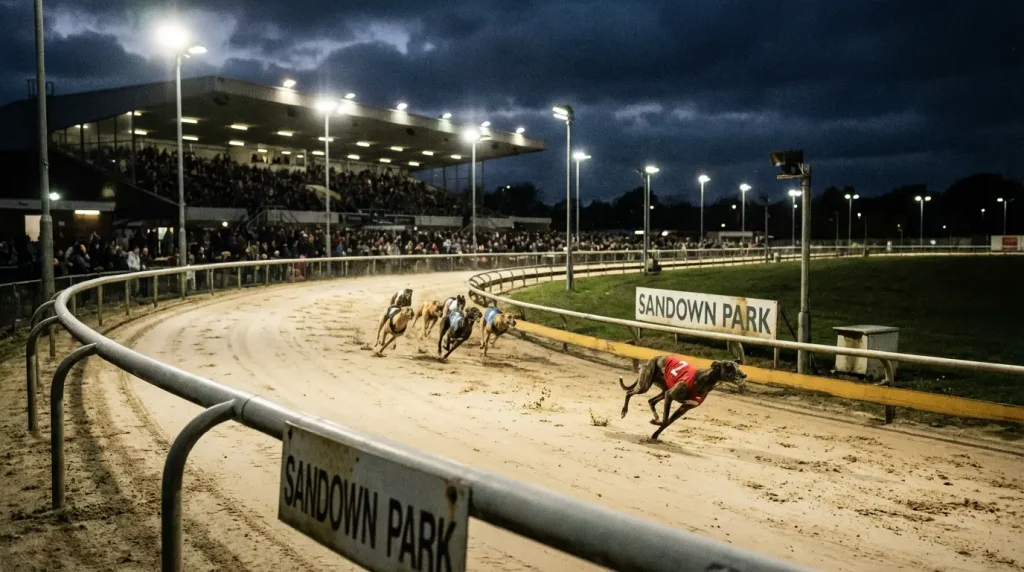
The First Bend Decides Most Races
In greyhound racing, early pace is not one factor among many — it is the factor. The dog that leads at the first bend wins more often than any other statistical predictor would suggest. Across UK tracks, studies of finishing data consistently show that the first-bend leader converts to a race winner somewhere between 35% and 50% of the time, depending on the track and distance. In a six-dog field where a random distribution would give each runner a 16.7% chance, that is a massive structural advantage.
For forecast bettors, this correlation has a direct practical implication. If you can reliably identify which dog will lead at the first bend, you have your strongest candidate for first place. And if you can identify which dog will sit in second at the first bend — the one that gets a clean run without being checked or crowded — you have a strong starting point for the runner-up position. Forecast betting, at its core, is an exercise in predicting the race shape from trap to first bend. Everything after that matters less than most punters think.
This article explains why early pace dominates greyhound finishing order, how to measure it from publicly available data, and how to use it as the primary filter in your forecast selections.
Why Early Pace Matters More Than Finishing Speed
Greyhound races are short. A standard 480-metre race at a UK track takes around 29 to 30 seconds. There is very little time for a dog that loses ground early to recover it later. Unlike horse racing, where a strong finisher can make up several lengths in a long home straight, greyhound racing rewards the dog that establishes position early and holds it. The physics of the sport — tight bends, narrow tracks, six dogs competing for limited space — mean that once a dog loses its running line at the first turn, it spends the rest of the race fighting for clear air rather than challenging for position.
The first bend is the critical moment. The six dogs leave their traps, accelerate across a short straight, and then converge on the first turn. The dog that reaches the bend first has the choice of position — typically the rail. The dog in second can slot in behind or just off the leader’s shoulder. The dogs further back are forced to navigate around others, lose momentum, and often emerge from the bend three or four lengths adrift with only two turns and a short straight remaining. That deficit, in a race lasting under thirty seconds, is usually fatal.
This is why pace, not speed, is the relevant metric. A dog can have the fastest finish time in its grade but consistently miss the first bend and finish third or fourth because it gets trapped behind slower dogs. Conversely, a dog with a slightly slower overall time but superior early pace can reach the bend first, control the race, and win comfortably. For forecast selection, the fast-starting dog that controls the bend is far more valuable than the fast-finishing dog that relies on others making mistakes.
There is a secondary effect worth noting. The first-bend leader often dictates the pace of the entire race. If the leader runs at a consistent speed, the chasers must match it, and the finishing order often reflects the order established at the bend. If the leader fades in the closing stages, the dog immediately behind — the one in second at the bend — is best positioned to take over. Either way, the first two dogs at the bend are disproportionately likely to be the first two dogs across the line.
Measuring Early Pace
Early pace is measurable, and the data is more accessible than most punters realise. The most direct indicator is the sectional time to the first bend — the split time from trap to the first timing point, which is typically positioned at or near the first turn. Not all tracks publish sectional times as standard, but many do, and services like Timeform and the Racing Post include them in their enhanced race card data.
When sectional times are available, the comparison is simple. A dog that consistently records first-bend splits of 4.20 seconds at a given track has faster early pace than one recording 4.35 seconds. Over four or five runs, these numbers give you a reliable picture of how quickly each dog exits the traps and reaches the bend. A difference of 0.10 to 0.15 seconds at the first split is meaningful — it translates to roughly half a length to a length of advantage at the bend, which is often the margin that separates the leader from the pack.
When sectional times are not available, you can infer early pace from three other data points on the race card. First, look at the finishing comments from recent races. Phrases like “led first bend,” “early pace,” “fast away,” or “disputed lead” indicate a dog with natural speed out of the traps. Second, look at the trap draw relative to the dog’s recorded running style. A dog described as a “railer” drawn in Trap 1 or 2 will likely reach the first bend with a positional advantage. Third, look at the overall run times in the context of finishing position — a dog that wins its races in fast times from the front is a pace dog, even if the explicit split time is not listed.
One important caveat: early pace is partly a function of trap draw. A dog with moderate natural speed drawn in Trap 1 at a track with short run-ups may lead the first bend simply because the geometry favours it. The same dog drawn in Trap 6 at the same track might be three lengths behind at the same point. When assessing early pace for forecast purposes, always consider the trap draw on the day, not just the historical split times. A dog moving from Trap 1 to Trap 5 for its next race will likely lose first-bend advantage, regardless of its recorded speed.
First-Bend Position and Forecast Correlation
The correlation between first-bend position and finishing position is the strongest predictive relationship in greyhound racing. The dog that leads at the first bend finishes first or second in approximately 60-70% of races, depending on the track. The dog in second at the first bend finishes in the first two positions roughly 40-50% of the time. By the time you reach the dog in fifth or sixth at the first bend, the probability of finishing in the forecast places drops to single digits.
For forecast bettors, this data transforms the selection process. Instead of analysing all six dogs equally and trying to predict the first two home from a field of thirty possible combinations, you can narrow the analysis to the two or three dogs most likely to be at the front of the pack when the field hits the first turn. This reduces your effective field from six to three, and your forecast combinations from thirty to six — a far more manageable analytical challenge.
The dogs most likely to lead at the first bend are those with the fastest early pace from their drawn trap position. If Trap 2 has a fast-starting railer and Trap 5 has a dog with moderate pace, the bend dynamics at most tracks will favour Trap 2 regardless of what Trap 5’s overall time looks like. The forecast that pairs the probable bend leader with the probable second-place runner through the bend is, statistically, the highest-probability combination you can construct.
There are exceptions. At longer distances — 640 metres and above — the first bend is less decisive because the race covers more ground and there are additional bends where positions can shift. At tracks with particularly wide, sweeping first bends, dogs can recover lost ground more easily than at tight circuits. And in open races with large class differentials, a markedly superior dog can overcome a poor first bend through sheer ability. But in standard graded racing over 480 metres, the first-bend correlation holds firmly, and building your forecasts around it is the single most effective analytical approach available.
Reading Pace on the Race Card
When you open a race card for a six-dog graded race, the pace analysis should take about two minutes. Scan each dog’s recent form for evidence of early speed: first-bend split times if available, race comments mentioning early pace, and the trap draw on the day relative to the dog’s preferred running position. Mark the one or two dogs that are most likely to lead at the bend. These are your primary forecast candidates.
Then assess the runner-up possibilities. Which dog is likely to sit just behind the leader through the first bend? Often, this is a dog with decent pace drawn in an adjacent trap — the dog in Trap 2 when the leader is in Trap 1, or the dog in Trap 4 when the leader is in Trap 3. Proximity matters because dogs that are physically close to the leader at the bend tend to stay close through the rest of the race.
Finally, check for potential pace collapses. If two or three dogs have very similar early-pace profiles, they may contest the lead aggressively into the first bend, checking each other and allowing a backmarker to sweep through. This scenario is harder to forecast but worth noting — when it happens, the usual pace-based analysis breaks down, and the dog that avoids the trouble at the bend becomes the value selection.
Pace as a Prediction Tool
Early pace is not the only factor in greyhound forecast selection, but it is the one that deserves the most weight. A forecast built on pace analysis will, over a large sample of bets, outperform one built on overall time, recent finishing position, or market price alone. The reason is structural: greyhound racing is a sport where the first bend decides most races, and early pace is the variable that determines first-bend position. Everything else is secondary.
Treat pace as your anchor. Build your forecast around the likely bend leader and the likely second through the bend, then adjust for trap draw, running style, and form. That hierarchy — pace first, refinements second — is the most productive framework for consistent forecast returns.
Get more race analysis at greyhoundforecast.
Also read our trap draw bias in greyhound forecasts.
